You are staring at the pot in the middle of the table. You hold five cards of the same suit, forming a beautiful flush. Across the table, your opponent pushes their chips forward and proudly announces a full house.
If your heart just skipped a beat because you are not sure who collects the chips, you are not alone. Beginner and intermediate poker players frequently mix up this specific hand matchup. Remembering the hierarchy can feel confusing when both holdings look impressive.
Let us clear up the confusion once and for all so you never have to hesitate during a live game.
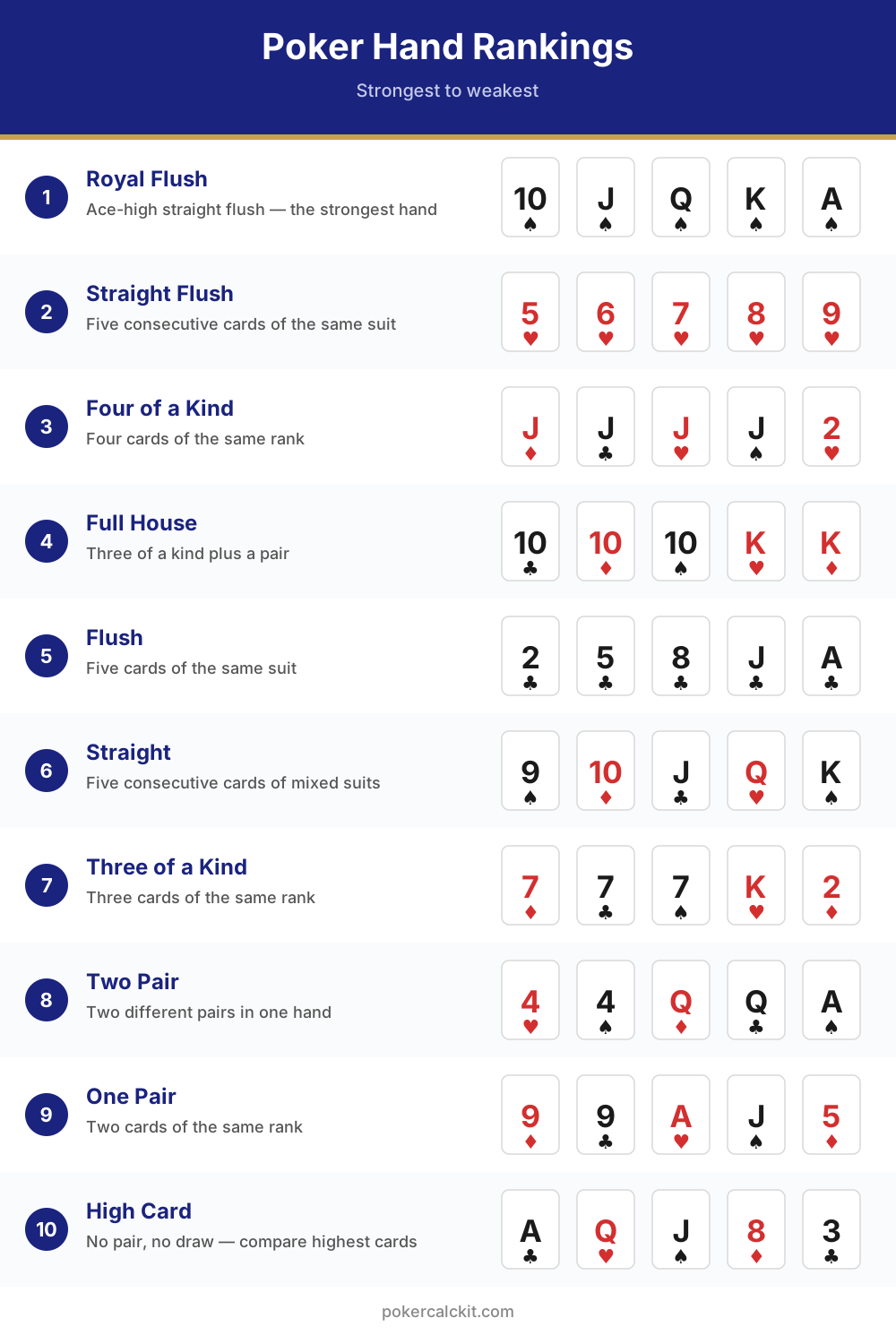
Quick Answer
A full house always beats a flush in standard poker rules.
A full house outranks a flush because it is mathematically rarer to hit in a standard 52-card deck.
Why: Hand Frequency and Math
Traditional poker hand rankings follow a strict logic based on scarcity. The harder a hand is to assemble, the higher it sits on the leaderboard. When two players showdown their cards at the end of a round, the rarer five-card combination wins the pot.
To understand why this happens, we need to define the technical terms behind both hands.
A suit refers to one of the four categories of cards in a deck: hearts, diamonds, clubs, or spades. A rank refers to the numerical value or face value of a card, running from two up to ace.
A flush is a five-card hand where every single card belongs to the exact same suit, regardless of their numerical order. For example, holding the two, five, eight, jack, and king of hearts gives you a heart flush.
A full house is a five-card hand built from two different components: three cards of the same rank, combined with two cards of another rank. Players also call this hand a boat. An example is three tens and two fours, commonly described as tens full of fours.
To see why the full house sits higher, look at a standard five-card deal from a 52-card deck:
A straight consists of five cards in sequential numerical order across mixed suits, such as five, six, seven, eight, and nine. A straight accounts for 10,200 combinations with probability 0.3925%, about 1 in 255 hands.
A flush accounts for 5,108 combinations with probability 0.1965%, about 1 in 509 hands. Because 5,108 combinations are fewer than 10,200 combinations, a flush easily beats a straight.
A full house accounts for 3,744 combinations with probability 0.1441%, about 1 in 694 hands. Because 3,744 combinations are rarer than 5,108 combinations, the full house wins every single time.
| Hand | Combinations | Probability | Frequency |
|---|---|---|---|
| Straight | 10,200 | 0.3925% | About 1 in 255 hands |
| Flush | 5,108 | 0.1965% | About 1 in 509 hands |
| Full House | 3,744 | 0.1441% | About 1 in 694 hands |
The numbers settle the debate completely. You are substantially less likely to land a full house than a flush.
When It Gets Tricky
Knowing the basic hierarchy is only half the battle. Real poker games introduce board textures and variations that can complicate how you read your hand.
The Board Pairing Danger
In community card games like Texas Hold’em, players construct their best five-card hand using their private hole cards and the shared community cards. Hole cards are the secret cards dealt face down to you at the start of a hand. Community cards are the cards dealt face up in the middle of the table for everyone to share.
When you hold a flush, you must always look out for board pairing. A board pairing happens when two or more community cards share the exact same rank.
Suppose the community cards show the king of spades, nine of spades, four of spades, four of hearts, and two of diamonds. You hold the ace of spades and seven of spades, giving you an ace-high flush.
However, because the board paired the fours, any opponent holding a single four alongside a king, nine, or two now holds a full house. Even though your flush contains the highest possible card, their full house crushes your hand. When the board pairs, a flush loses much of its hidden strength.
The Straight Flush Exception
Beginners sometimes confuse a regular flush with a straight flush. A straight flush is five consecutive cards of the identical suit, such as the seven, eight, nine, ten, and jack of clubs.
A straight flush is an entirely separate category in the poker hierarchy. It sits near the very top of the ranking chart and comfortably beats a full house. If your flush cards run in sequential order, you do not just have a flush; you have a monster that defeats any full house.
Breaking Ties Within the Same Hand
What happens when multiple players hit the same hand category?
If two players make a full house, the rank of the three-of-a-kind determines the winner. Three aces with two deuces beats three kings with two aces. If the three matching cards are shared on the community board, the player with the higher pair wins.
If two players complete a flush, the player holding the highest individual card takes the pot. An ace-high flush beats a king-high flush. If both players share the same top card, the game compares the second-highest card, continuing down to the fifth card if necessary.
Frequently Asked Questions
Does a flush ever beat a full house in any poker variant?
Not in any standard poker game. Across Texas Hold’em, Omaha, Seven-Card Stud, and Five-Card Draw, the full house always beats the flush. Some niche home games or wild-card variations might invent custom rules, but in all official poker formats, the full house maintains its superiority.
What is the best possible full house you can make?
The highest possible full house is three aces combined with two kings, commonly called aces full of kings. It beats every other full house combination in the deck, including aces full of queens and kings full of aces.
Can two players tie with a flush?
Yes, but only if all five highest suited cards are identical for both players. This usually happens in community card games when all five community cards share the same suit and neither player holds a card in that suit higher than the lowest card on the board. In that case, both players share the pot equally.
Why do some beginners think a flush beats a full house?
A flush often looks visually cleaner and harder to find. Getting five cards of the same color and symbol feels like an incredible feat. In contrast, a full house looks like two ordinary low-ranking hands smashed together. This visual trick leads new players to assume the flush must be rarer.
Summary
In any standard poker showdown, a full house defeats a flush without exception. The mathematical truth is undeniable: landing a full house requires navigating through far fewer combinations than hitting a flush. Keep a close watch on paired community boards, watch out for sneaky straight flushes, and play your big hands with confidence.
If you want to test your knowledge against real situations, you can use the interactive matchup tool on pokercalckit.com to run hand scenarios. When you feel ready to put that knowledge to work, jump into the tournament action on VG.Poker and put your skills to the test.
Educational content. 18+ only.
DADOS USADOS
- A full house accounts for 3,744 combinations with probability 0.1441%, about 1 in 694 hands
- A flush accounts for 5,108 combinations with probability 0.1965%, about 1 in 509 hands
- A straight accounts for 10,200 combinations with probability 0.3925%, about 1 in 255 hands