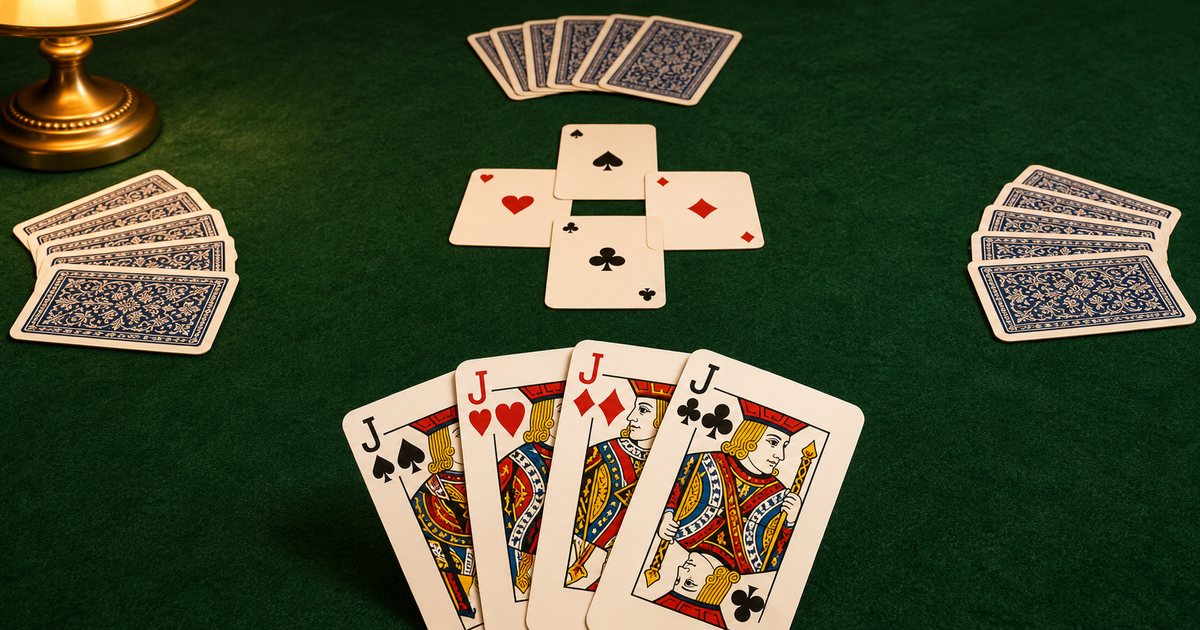
Euchre is a four-player trick-taking game played by two partnerships. Each player gets five cards from a 24-card deck; players then decide which suit will be trump. The team that names trump tries to win at least three of the five tricks. The unusual part is that the two highest trump cards are both Jacks, including one Jack that normally belongs to a different suit.
This guide uses the common North American 24-card version: A, K, Q, J, 10 and 9 in each suit, no joker, with games played to 10 points. Other tables may use 32 cards, add a joker, or choose a different target score.
The deck, partners, and deal
Remove every card from 2 through 8 from a standard deck. Seat partners opposite each other. Deal five cards to each player in two packets, using the same packet pattern for every player. Place the remaining four cards face down as the kitty and turn its top card face up. That up-card helps determine trump.
The dealer rotates clockwise after each hand. The four players take turns clockwise, and the person to the dealer’s left speaks first when deciding whether to order up the turned card.
What are the right and left bowers?
The right bower is the Jack of the trump suit and is the highest card in the hand. The left bower is the other Jack of the same color and is the second-highest trump. If Hearts are trump, J♥ is the right bower and J♦ is the left bower. The left bower counts as a Heart for that hand, not as a Diamond.
After the two bowers, trump ranks A, K, Q, 10, 9. In a non-trump suit, cards rank A, K, Q, J, 10, 9. Remembering that the left bower changes suits is essential: if Hearts are led, a player holding only J♦ can follow with it because that Jack is treated as a Heart.
How to call trump
There are two rounds to name trump:
- Order up or pass. Starting left of the dealer, each player may accept the turned-up suit as trump or pass. If someone orders it up, the dealer picks up the up-card and discards one card face down.
- Name another suit or pass. If everyone passes, the dealer turns the up-card face down. Each player may name a different suit as trump or pass. The rejected suit cannot be named. If all four pass again, the hand is redealt by the next dealer.
The partnership that names trump is the makers. Its goal is to take at least three tricks. The other pair are the defenders, trying to stop them. If the makers take fewer than three tricks, they are euchred.
Playing the five tricks
The player left of the dealer leads the first card. Everyone must follow suit if able. If you cannot follow, you may play any card, including a trump. The highest card of the suit led wins unless a trump is played; then the highest trump wins. The trick winner leads the next one.
Example: the left bower follows trump
Suppose Hearts are trump and Clubs are led. A player who holds J♦ but no Clubs is void in Clubs, so they may play J♦ as a trump. It counts as a Heart, and beats any Club. If another player then plays J♥, the right bower wins because it outranks the left bower.
Euchre scoring with an example
Each hand is worth one or two points for the makers, or two for the defenders if the makers are euchred:
| Result | Score |
|---|---|
| Makers take 3 or 4 tricks | Makers +1 |
| Makers take all 5 tricks (a march) | Makers +2 |
| Makers take 0, 1, or 2 tricks (euchred) | Defenders +2 |
| A maker goes alone and takes all 5 tricks | Makers +4 |
| A defender goes alone and euchres the makers | Defenders +4 |
For example, if your team names Spades and takes four tricks, your team scores 1 point. If the defenders take three tricks, they euchre your team and score 2 instead. First team to 10 points wins in the version used here; agree on the target before the first deal.
Going alone is an optional decision after trump is named: the player believes their hand is stronger without the partner’s cards, so the partner sits out that hand. Under these scoring rules, a lone maker who sweeps all five tricks earns 4 points. A lone maker who takes only three or four scores 1, just as a partnership would. A lone defender who takes at least three tricks and euchres the makers also earns 4 points.
Common questions
What is the difference between the right and left bower?
The right bower is the Jack of trump and ranks first. The left bower is the Jack of the same color as trump and ranks second; it also counts as belonging to the trump suit.
What does it mean to get euchred?
The team that named trump is euchred if it wins fewer than three of the five tricks. The defenders score 2 points in the version on this page.
How many cards are in a Euchre deck?
This guide uses 24 cards: 9, 10, J, Q, K and A in each suit. Some regions and house rules use a 32-card deck or add a joker, so check the deck before dealing.
Version and sources
The bower ranking, trick goal and basic score are checked against Bicycle’s Euchre rules. The 24-card North American deck, second-round trump call and common 10-point target are checked against Pagat’s Euchre rules. Euchre has regional differences in deck size, dealer rules, lone-hand scoring and winning target; the version named at the top is the one explained here.
Data Used
Rules and scoring details were checked against Bicycle and Pagat’s Euchre rules on November 24, 2026. The examples use a 24-card deck and a game target of 10 points; regional house rules may differ.
For another four-player trick-taking game, see Spades rules. Browse the card game directory to compare games by group size and play style.
This page is for learning a card game. It does not recommend playing for money.
Educational content. 18+ only.