Uncalled bet returned to the bettor when everyone folds

Uncalled Bet Returned in Poker: What Happens When No One Calls

An uncalled bet returned in poker means that whenever you place a bet or raise and no other player matches that amount, the unmatched excess is returned once betting action is complete. The pot includes committed chips from players who later fold, as well as applicable blinds and antes. Returning an unmatched excess does not remove those contributions. Understanding how bets are handled will help you calculate your position clearly. You can learn more about how bet sizes relate to the reward by reviewing what are pot odds in our basic strategy series. ...

November 28, 2026 · 5 min
Why Doug Polk Bet Just 9% of the Pot on the Turn

Why Doug Polk Bet Just 9% of the Pot on the Turn

A $200,000 turn bet looks tiny next to a pot over $2 million. The broadcast graphic puts the size at about 9.2% of the pot (roughly 9%). It sounds too small to matter until you hear Polk’s explanation: he was using a small size with his whole range, not simply trying to get maximum value from pocket nines. That distinction makes the hand more interesting than the headline suggests. The bet was meant to influence what Negreanu could do with many different hands—and to make the river easier to play. ...

November 28, 2026 · 5 min
Drawing Dead in Poker: When No Card Can Save You

Drawing Dead in Poker: When No Card Can Save You

Drawing dead means a draw that cannot win even if it completes. In Texas Hold’em, a draw is a hand waiting for specific cards to improve, such as a flush draw or a straight draw. Your hand is drawing dead when no unseen card can turn it into the winning hand, because an opponent already holds a hand that beats everything you can make. The draw may succeed perfectly, and you still lose the showdown. ...

November 27, 2026 · 6 min
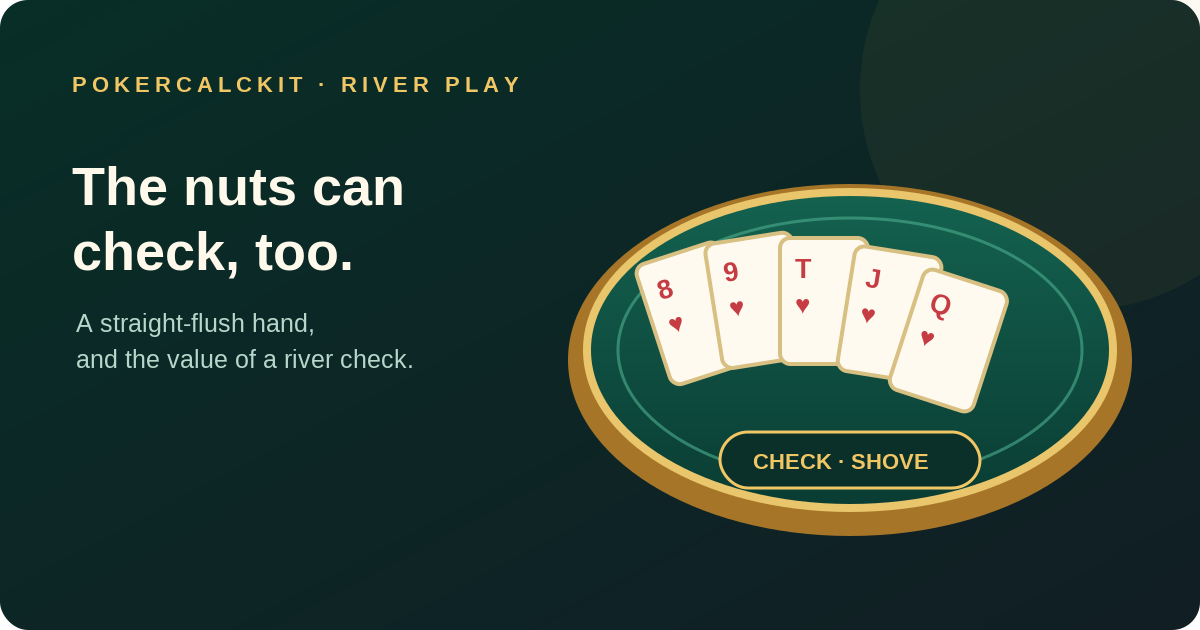
A straight-flush hand and a river decision between checking and shoving

He Had a Straight Flush. Why Did the Solver Prefer a Check?

Making a straight flush feels like permission to put every chip in. Ossi Ketola did exactly that against Patrik Antonius. But when PokerNews ran the hand through GTO Wizard, the solver preferred a check on the river with Ketola’s exact cards. That is not a claim that checking the nuts is always clever. It is a useful example of a narrower idea: a hand can be unbeatable at showdown and still block too many of the hands that would pay a big bet. ...

November 27, 2026 · 4 min
A short stack marked by one gold chip at a green tournament poker table, with another table in the distance

A Player Is All-In for One Ante on the Bubble: Does Their Table Matter?

A tournament player who has less than one ante may be forced all-in when the ante is posted. This is mainly an online tournament spot today: many live events use a big-blind ante, which changes how the ante is posted and makes this exact situation less common. Check the event’s structure before applying the example. PokerStrategy describes the spot as one that still occurs online after big-blind antes became common in live poker. ...

November 26, 2026 · 5 min
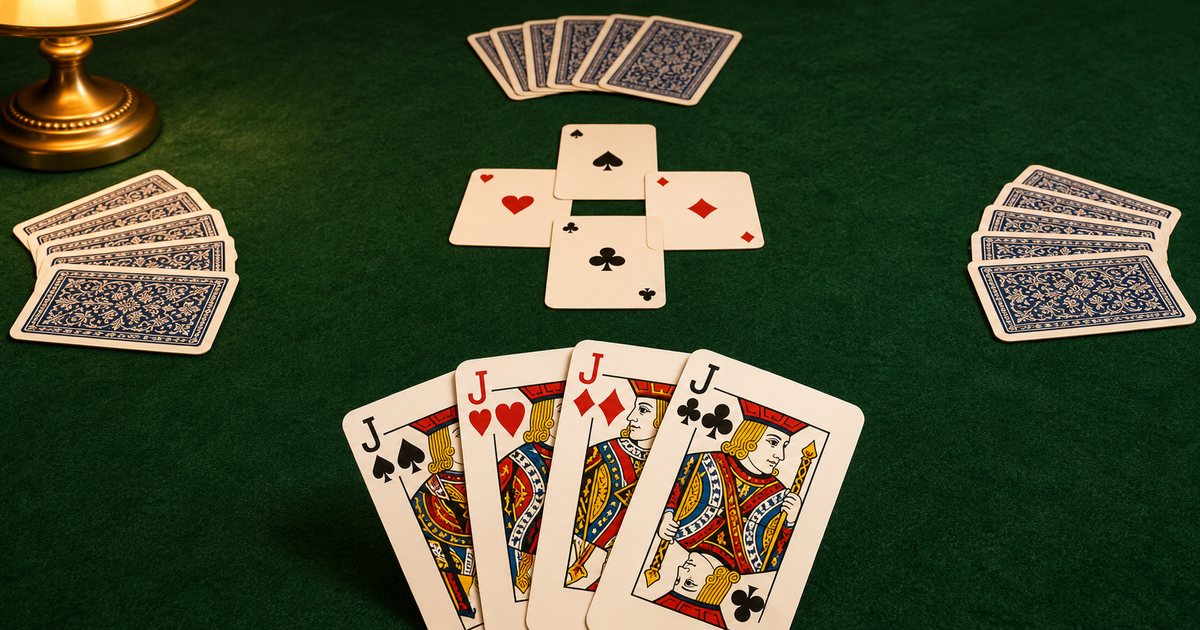
Cop and Robbers card game roles, deal and scoring

Cop and Robbers Card Game Rules: Roles, Deal, and Scoring

Cop and Robbers is a social point-scoring card game for at least four players. The game uses a custom role deck containing exactly one card per player: one ace for the cop, one jack for the robber, and other ranks for civilians. The robber tries to stay hidden and earn points from wrong guesses, while the cop tries to identify the robber after a civilian announces that the deal has been made. This guide covers the selected single-cop, single-robber, non-drinking version. ...

November 26, 2026 · 6 min
Traditional Euchre cards arranged on a green felt table

Euchre Rules: How to Play with Four Players

Euchre is a four-player trick-taking game played by two partnerships. Each player gets five cards from a 24-card deck; players then decide which suit will be trump. The team that names trump tries to win at least three of the five tricks. The unusual part is that the two highest trump cards are both Jacks, including one Jack that normally belongs to a different suit. This guide uses the common North American 24-card version: A, K, Q, J, 10 and 9 in each suit, no joker, with games played to 10 points. Other tables may use 32 cards, add a joker, or choose a different target score. ...

November 24, 2026 · 5 min
Hearts and spade cards laid out on a green felt table

Hearts Rules: How to Play, Score, and Shoot the Moon

Hearts is a four-player trick-taking game where the lowest score wins. Each player gets 13 cards, passes three cards before most hands, then follows suit while trying to avoid Hearts and the Queen of Spades. Every Heart is worth 1 penalty point; the Queen of Spades is worth 13. This guide follows a common four-player version and uses Bicycle’s scoring rule for shooting the moon. Set up the deck and pass cards Use a standard 52-card deck with no jokers. Deal all the cards one at a time, clockwise, so every player has 13. Before the first trick, each player chooses three cards and passes them face down. Use this cycle: pass left, pass right, pass across, then keep your hand with no pass; repeat it for the next four deals. Choose what to pass before picking up the cards sent to you. ...

November 24, 2026 · 5 min
A deck of playing cards spread across a green card table

Manni Card Game: Rules and How a Round Is Played

Manni is a three-player trick-taking card game played with a 48-card pack and a twelve-card spare hand. The name means “little man” or “chap” in Icelandic and names the spare hand. Each player receives twelve cards, and players compete across twelve tricks per deal. Only tricks won above four earn points, and the game continues until at least one player reaches ten points, with the highest total winning. This guide follows the basic Icelandic Manni version in the cited rule reference. It does not combine rules from other Manni variants. ...

November 24, 2026 · 5 min
Spades cards laid out on a green felt table

Spades Rules: How to Play, Bid, and Score

Spades is a four-player trick-taking game played by two partnerships. Partners sit opposite each other, every player receives 13 cards, and Spades are always trump. Before play, each person predicts how many tricks they will take; partners add those bids together and try to make the team contract. This guide uses the common 52-card partnership version, with Nil bids and standard bag scoring. What you need and how to deal Use one standard 52-card deck, with no jokers. Choose a dealer, then deal every card face down one at a time, clockwise, starting with the player on the dealer’s left. Each person sorts their 13 cards by suit. The next deal passes clockwise. ...

November 24, 2026 · 5 min
Play Free Now Poker instantly in your browser - no download, free chips for new players First load may take a moment - thanks for your patience.
Contact Us