Playing cards and poker chips arranged beside probability notes

Why AA Drops to 72% Against Two Players (and Why Halving Is Wrong)

You know aces are about 85% against one random hand. Two opponents walk in. Quick mental math says your equity should be roughly half of 85, so about 42%. It is actually around 72%. That gap — thirty points, not a rounding error — is the whole reason heads-up equity numbers do not transfer to multiway pots. Not adjusted. Not divided. They just do not transfer. The aces test Simulated over 20,000 random runouts, A♠ A♥ holds: ...


November 24, 2026 · 4 min
A deck of playing cards spread across a green card table

Nines Card Game Rules: Complete Nine-Card Golf Guide

Here, Nines means the four-player, nine-card Golf version in the cited reference, not every game sharing that name. Using two standard 52-card decks without jokers, each player is dealt a three-by-three grid of nine cards. On each turn, players draw from the stock or discard pile to replace cards in their grid and lower their point total. Matching three equal ranks in a vertical column cancels those cards to zero points. The player with the lowest cumulative score after nine deals wins the game. ...

November 23, 2026 · 5 min
Playing cards and poker chips arranged on a green felt table

Run It Twice in Poker: Same EV, Smaller Swings

When the last cards are dealt twice after an all-in, the pot is divided between two board runouts. The split changes how the hand finishes, but with the same deck and pot it does not change either player’s expected share. Here is a turn example that makes the difference visible. Quick answer In a fixed five-out turn example, one river gives the drawing player an 11.36% expected share of the pot. Two rivers make a split more common, but the expected share remains 11.36%. Running it twice changes how the result is distributed, not the price or equity of the call that created the all-in. ...

November 23, 2026 · 6 min
ReBeL authors’ stated poker-code release decision

Why ReBeL's Authors Withheld the Poker Code

ReBeL’s authors stated in their 2020 paper that they would withhold their poker implementation. The authors say this directly in the paper: “Partly for this reason, we have decided not to release the code for poker.” The statement concerns the authors’ release decision in that paper. It does not prove that no later implementation exists. What was published, and what was not The dated paper is the evidence used here. ...

November 21, 2026 · 5 min
A deck of playing cards spread across a green card table

Palace Rules: The Selected Version Explained

Palace, in the selected Pagat base Shithead/Palace version, is a four-player shedding card game played with a standard 52-card deck and no jokers, where twos reset the pile, tens clear it, and the last player holding cards loses. Every player starts with nine cards split across three zones: three face-down table cards, three face-up table cards, and three hand cards. This leaves 16 cards in the central stock pile after the initial deal. The rules below follow the baseline specification documented on Pagat and exclude optional house rules. ...

November 20, 2026 · 6 min
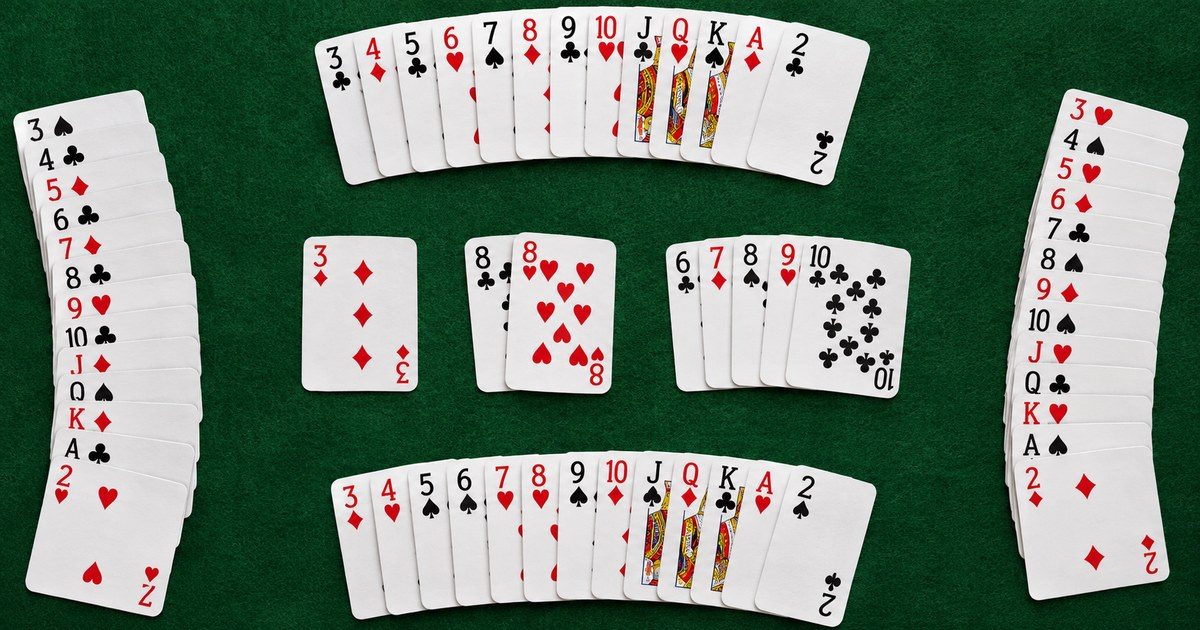
Four Big Two hands surrounding a three of diamonds, a pair and a five-card straight

Big Two Rules: Agree the Variant Before the First Lead

Four players sort 13 cards each, and one question should come before anyone leads: which version of Big Two is this table using? The game keeps the same central idea across regions—shed cards by beating the current play—but suit order, straights, flushes and the effect of passing can change. This guide uses the four-player baseline documented by Pagat: ranks run from 2 high to 3 low, suits run Spades, Hearts, Clubs, Diamonds, and the holder of the 3 of Diamonds opens. ...

November 19, 2026 · 6 min
Playing cards and poker chips arranged on a green felt table

Bomb Pot Poker: Single and Double Board Rules Explained

A bomb pot is a hand where players contribute chips before the deal and the action begins on the flop, with no preflop betting round. A double-board bomb pot deals two separate community boards, and the pot is divided between the winning hands on those boards. The two boards are not combined into one larger board. This page uses a specific four-card Pot-Limit Omaha, high-only example; bomb-pot house rules can differ. ...

November 19, 2026 · 6 min
Classic card games compared by players, goal, and style of play

Card Games: Rummy, Go Fish, Spoons and More, Compared

Looking for a card game for two people, a family table, or a larger group? The best choice depends on how many people are playing and what kind of round sounds fun: matching sets, collecting cards, reacting quickly, avoiding penalty points, or bidding for tricks. This guide compares twelve card games with rules on this site so you can choose a starting point and then learn the details. Choose a card game Each card links to the selected rules version taught on this site. Player counts describe that version, rather than every possible house rule. ...

November 19, 2026 · 7 min
A comparison of nine poker variants and how their rules differ

Poker Variants Compared: Hold'em, Omaha, Stud, Draw and More

You sit down at a table and someone deals you two cards. A few hands later, at a different table, you get four, and the player beside you starts talking about a low hand. Same family of games, different decisions. That difference is what separates poker formats. Some share community cards on the board, some keep every card in your own hand, and some let you swap cards mid-hand. Learn which one you are sitting at and the rest of the rules start to make sense. ...

November 19, 2026 · 8 min
Playing cards and poker chips arranged beside probability notes

Push Fold Chart: Reading Heads-Up Nash Stack Limits

In the HoldemResources heads-up push-fold chart, a value such as 7.7 is a maximum effective stack size in big blinds for that hand and action. It is not a win percentage or a recommended bet amount. The chart describes a narrow model: no ante, two players, the small blind may push all-in or fold, and the big blind may call or fold when facing a shove. It is not a universal tournament chart for every seat or table size. ...

November 19, 2026 · 6 min
Play Free Now Poker instantly in your browser - no download, free chips for new players First load may take a moment - thanks for your patience.
Contact Us