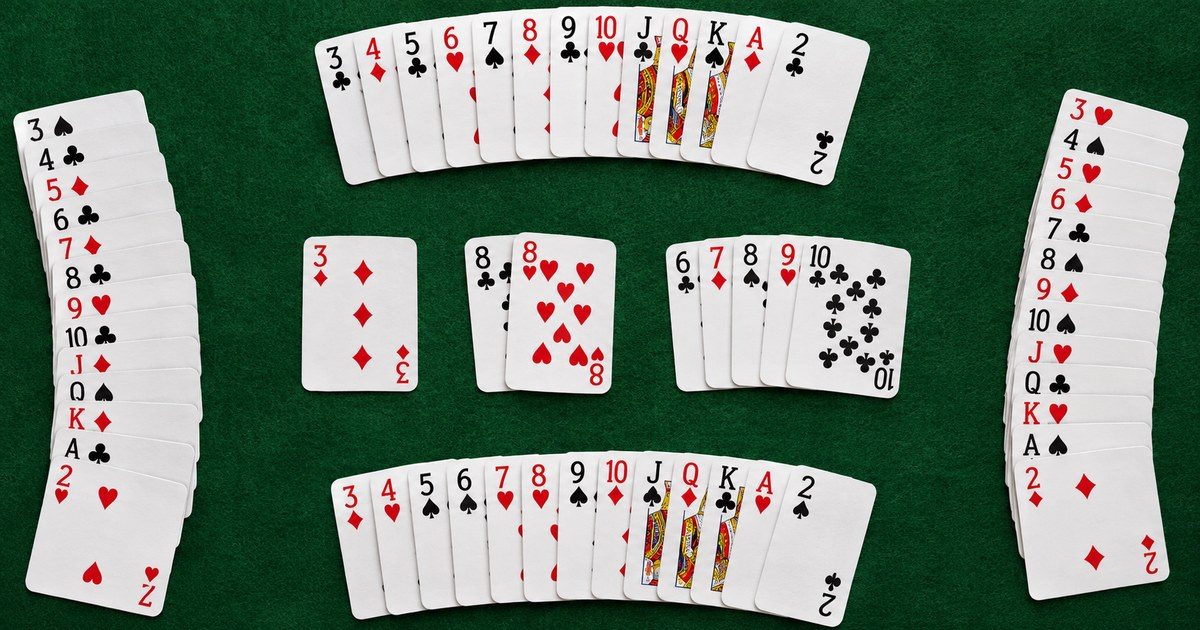
Four players sort 13 cards each, and one question should come before anyone leads: which version of Big Two is this table using? The game keeps the same central idea across regions—shed cards by beating the current play—but suit order, straights, flushes and the effect of passing can change. This guide uses the four-player baseline documented by Pagat: ranks run from 2 high to 3 low, suits run Spades, Hearts, Clubs, Diamonds, and the holder of the 3 of Diamonds opens.
Quick setup
Use one standard 52-card pack without Jokers. Four players compete individually, so there are no partners. Deal all the cards one at a time, normally anticlockwise, until everyone has 13.
| Item | Rule used in this guide |
|---|---|
| Rank, high to low | 2, A, K, Q, J, 10 down to 3 |
| Suit, high to low | Spades, Hearts, Clubs, Diamonds |
| Lowest card | 3 of Diamonds |
| First lead | Must include the 3 of Diamonds |
| Direction | Anticlockwise |
| Goal | Be first to play every card |
The suit order matters whenever two otherwise equal plays need a tiebreak. Under this baseline the 2 of Spades is the highest single card and the 3 of Diamonds is the lowest. Pusoy Dos uses a different order, so a Philippine player may expect Clubs to be lowest and the 3 of Clubs to start. Treat that as a variant, not an error.
The four legal play sizes
A turn contains one of four legal shapes:
- a single card;
- a pair of equal ranks;
- a triple of equal ranks;
- a five-card group.
To answer a play, match its number of cards. A pair can only be beaten by a higher pair; a triple cannot jump in over a pair. Singles, pairs and triples compare rank first. When equal-ranked pairs are compared, the pair containing the highest suit wins. For example, 9♠–9♦ beats 9♥–9♣ because Spades outrank Hearts.
Two pair is not a playable shape in this ruleset. Four of a kind also cannot be laid down as four cards by itself: it belongs inside a five-card group with one extra card.
How five-card groups rank
Five-card groups form their own ladder, from weakest to strongest:
- straight;
- flush;
- full house;
- four of a kind plus any fifth card;
- straight flush.
A stronger category beats every lower category. Any flush therefore beats any straight, even when the straight ends in an Ace. Within one category, use the relevant comparison:
- Straight: compare the highest card, then its suit if the ranks match.
- Flush: in this baseline, compare suit first; within the same suit, compare the highest card.
- Full house: compare the rank of the triple, not the pair.
- Four of a kind: compare the rank of the four matching cards; the fifth card does not decide it.
- Straight flush: compare the highest card, then the suit when the sequence matches.
This is one place where local agreement matters. Pagat notes that the usual Hong Kong method compares flushes by their highest card before suit. Do not import ordinary poker tie rules without asking, because Big Two gives suits a role that poker usually does not.
Straights in this baseline
Twos are highest as singles, pairs and triples, but the baseline moves them below 3 inside a straight. The highest straight is A-K-Q-J-10. At the low end, A-2-3-4-5 is the lowest straight, followed by 2-3-4-5-6, then 3-4-5-6-7. An Ace can sit at either end of a valid sequence, but not in the middle; Q-K-A-2-3 is invalid here.
These details are heavily varied. Some Hong Kong tables rank A-2-3-4-5 highest, some allow 2-A-K-Q-J, and others exclude certain wraparound sequences. Before the deal, name the highest and lowest legal straight aloud. That ten-second check prevents the most common rules dispute.
Opening and taking control
The holder of the 3 of Diamonds makes the first play, and that play must contain the card. It may be led alone, in a pair or triple of 3s, or in a legal five-card group. The next player to the right either beats that play with the same number of cards or passes.
When every other player passes in succession, the cards are cleared. The player who made the unbeaten play has control and may lead any legal shape. A new lead can switch from singles to pairs, triples or five-card groups.
Under the baseline described by Pagat, passing is a decision for that turn: if play continues around the table, a player who passed may act when the turn returns. Some regional rules lock a player out until the pile clears. Agree on this point before playing, because it changes whether a player can conserve a high 2 and re-enter later.
Worked round
Mei holds the 3 of Diamonds and opens with 3♦–3♣, a pair that includes the required starting card.
- Arun plays 6♦–6♥.
- Jo passes.
- Sara plays J♣–J♠.
- Mei passes.
- Arun passes.
- Jo passes.
Sara’s pair is now unbeaten, so the pile clears and Sara leads again. She chooses a five-card straight, 4♦–5♣–6♠–7♥–8♦. The other players must answer with a stronger five-card group. Arun cannot answer with three Queens because a triple has the wrong size. He could play a higher straight, any flush, any full house, four of a kind plus a fifth card, or a straight flush.
Suppose Jo answers with 5♥–6♦–7♣–8♠–9♥. It is a higher straight because its top rank is 9 rather than 8. Sara’s earlier control does not protect her lead; each new play must still survive the remaining players.
Ending the deal
The first player to play their last card or valid combination wins immediately. The others do not receive another turn to beat the final play. In Pagat’s baseline, each loser receives 1 penalty point per remaining card with 9 or fewer cards, 2 per card with 10–12, or 39 points for all 13; the winner receives none. Other tables use different multipliers, so agree on scoring and a session endpoint before the first deal.
Five rules to settle at the table
Use this checklist before shuffling:
- What is the suit order, and which 3 opens?
- Which sequences count as the highest and lowest straights?
- Are flushes compared by suit or by card ranks?
- Can a player return after passing?
- How are cards left in hand scored?
Big Two has little rules overlap with Crazy Eights beyond the broad goal of shedding cards: Crazy Eights follows suit or rank and uses a draw pile, while Big Two climbs through fixed single, pair, triple and five-card shapes. It therefore has enough independent value for its own page.
Source and scope
- Pagat, Big Two: https://www.pagat.com/climbing/bigtwo.html (checked 2026-11-19).
For the next game, put the five checklist answers beside the deck. If a disputed straight appears, use the agreed line rather than switching to a remembered regional rule halfway through the deal.
This content is for educational and entertainment purposes only.