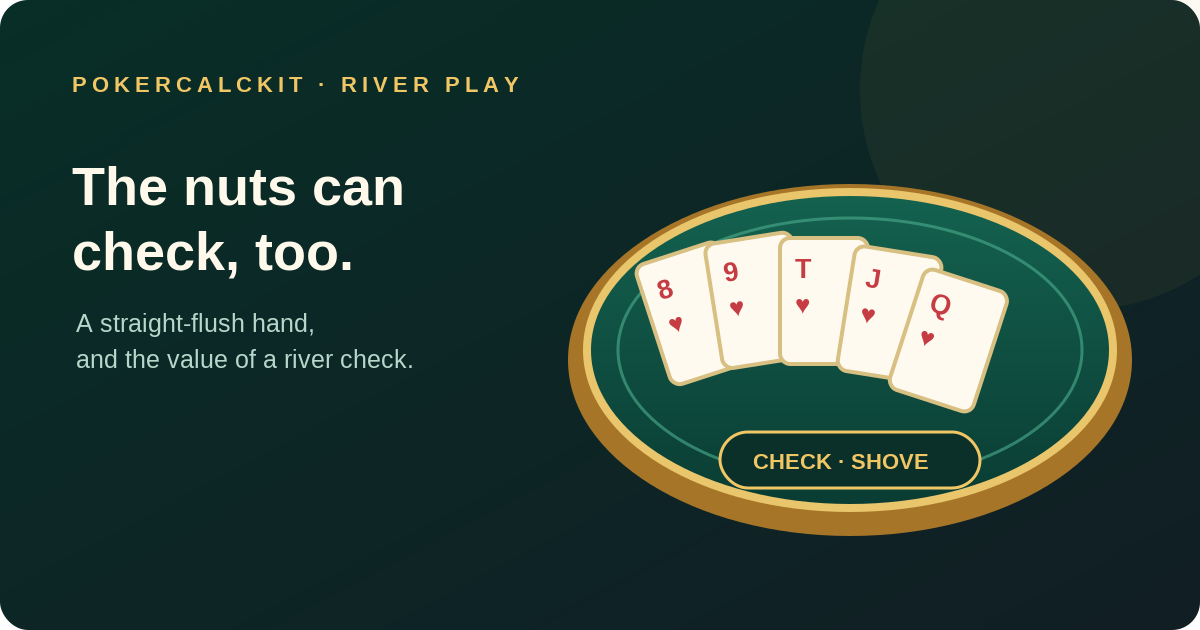
Making a straight flush feels like permission to put every chip in. Ossi Ketola did exactly that against Patrik Antonius. But when PokerNews ran the hand through GTO Wizard, the solver preferred a check on the river with Ketola’s exact cards.
That is not a claim that checking the nuts is always clever. It is a useful example of a narrower idea: a hand can be unbeatable at showdown and still block too many of the hands that would pay a big bet.
The hand, street by street
Antonius limped the button with K♦9♠. Ketola raised from the big blind to $350,000 with Q♥9♥, and Antonius called. The flop was Q♠ J♥ 8♥. Ketola checked, Antonius bet $175,000, and Ketola check-raised to $525,000. Antonius called.
The 10♥ came on the turn. Ketola checked again. Antonius bet $625,000, Ketola raised to $1.6 million, and Antonius called. The turn had given Ketola an eight-through-queen straight flush.
The river was 3♣. Ketola shoved. Antonius had about $4.1 million left to call and folded his straight.
What happened versus what the solver preferred
PokerNews’ analysis separates the hand’s actual line from the model’s recommendation:
| Street | What they did | What the analysis says about these exact hands |
|---|---|---|
| Flop | Ketola checked, then check-raised Antonius’ bet | Both actions with Q♥9♥ fit the solver’s strategy. Antonius’ K♦9♠ preferred checking over betting. |
| Turn | Ketola check-raised to $1.6 million | With the straight flush, the solver preferred calling Antonius’ $625,000 bet rather than raising. The hand needed no protection, and a call kept bluffs in. |
| River | Ketola shoved; Antonius folded | With Q♥9♥, the solver preferred checking. Its modeled calling range against a shove contained straights and flushes, not weaker hands. Antonius’ fold with K♦9♠ was also solver-approved. |
The comparison is not “Ketola played badly” or “the solver is always right.” The analysis uses specific ranges and bet sizes, and its river recommendation applies to this modeled spot.
Why the strongest hand can prefer a check
A value bet earns extra chips when a worse hand calls. A river shove can also make better hands fold, but with a straight flush there are no better hands to target. The useful question is: which worse hands will actually call this size?
Ketola’s Q♥9♥ removed some of the heart-flush and straight combinations that the model expected to call. That left fewer calls from hands he beat. Checking instead kept Antonius’ wider range in the hand and gave its bluffs a chance to bet. In this exact solver setup, that made checking more valuable than shoving.
This is a blocker effect. A card in your hand removes some combinations from your opponent’s possible holdings. For a bluff, removing likely calls can help. For a value bet, removing the weaker hands you want to call can hurt. Blockers matter because of the opponent’s range, not because the word “blocker” automatically means bet or check.
A practical river question
Before betting a very strong hand, name the worse hands you expect to call. Then ask whether your cards make those hands less available. If your opponent may bluff when checked to, compare that opportunity with the value a bet would collect.
The nuts tells you how the hand fares at showdown. It does not settle the bet-versus-check decision by itself. That is an expected-value comparison, and the answer can change with the opponent’s range, the size, and the prior action. This is a study example, not a universal instruction to slow-play strong hands.
FAQ
Should you always check the nuts on the river?
No. Sometimes worse hands call a bet often enough that betting is best. Checking is more attractive when the bet removes likely bluffs or when your cards block many worse calls. The right comparison depends on the range and size.
Did Antonius have a king-high straight?
No. With K♦9♠ on Q♠ J♥ 8♥ 10♥ 3♣, his best straight is 8-9-10-J-Q, a queen-high straight. The king is not part of those five cards.
Does this prove Ketola’s shove was a mistake?
It shows that one solver analysis preferred a check with Q♥9♥ under its modeled assumptions. A solver recommendation is not a universal verdict on a live hand, and Antonius did fold to the shove.
Data Used
- Hand: Ossi Ketola held Q♥9♥; Patrik Antonius held K♦9♠. Board: Q♠ J♥ 8♥ / 10♥ / 3♣. Antonius made a queen-high straight, not a king-high straight.
- Reported actions and sizes: Ketola raised preflop to $350,000; flop check-raise to $525,000; turn check-raise to $1.6 million; river shove. Antonius had about $4.1 million left to call and folded.
- Solver comparison: PokerNews’ GTO Wizard analysis says the modeled line prefers a turn call and river check with Q♥9♥; these are tied to its ranges and sizing, not universal rules.
- Sources: Triton Poker’s original heads-up stream, hand segment around 4:15 (visual reference previously checked); PokerNews’ GTO Wizard street-by-street analysis, published September 22, 2026 and reopened for this review.
- Amount note: omitted the disputed total-pot figure and the promotional $15.925 million headline; the draft describes Antonius’s remaining effective amount to call.
- Checked: 2026-11-27.
Educational content. 18+ only.