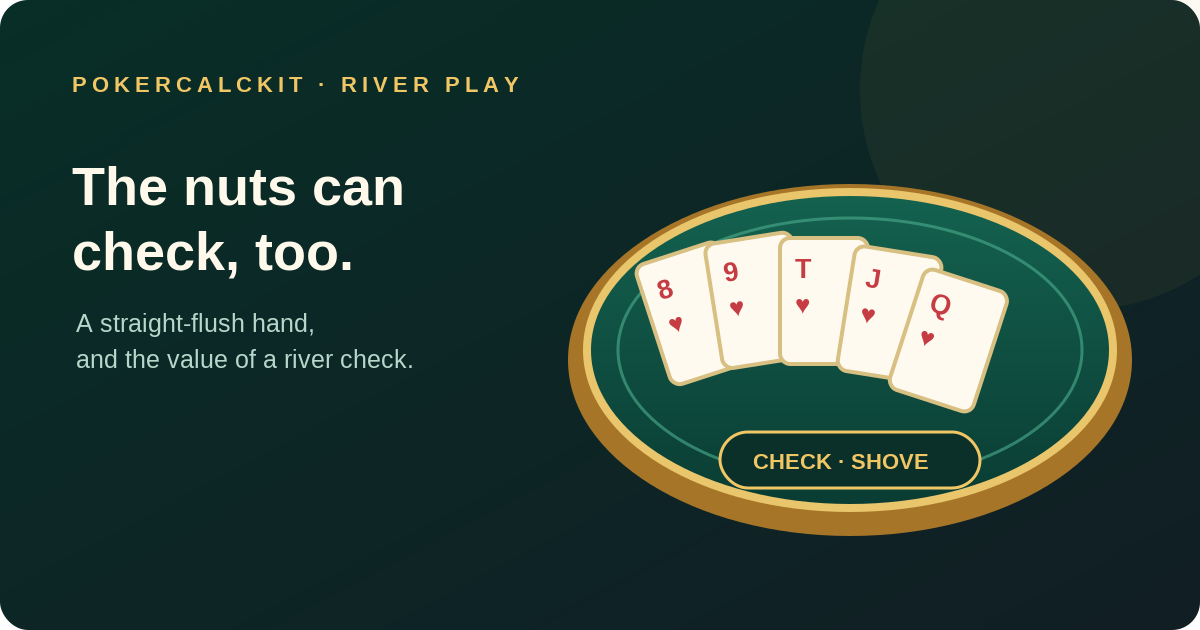
A straight-flush hand and a river decision between checking and shoving

He Had a Straight Flush. Why Did the Solver Prefer a Check?

Making a straight flush feels like permission to put every chip in. Ossi Ketola did exactly that against Patrik Antonius. But when PokerNews ran the hand through GTO Wizard, the solver preferred a check on the river with Ketola’s exact cards. That is not a claim that checking the nuts is always clever. It is a useful example of a narrower idea: a hand can be unbeatable at showdown and still block too many of the hands that would pay a big bet. ...

November 27, 2026 · 4 min
Playing cards and poker chips arranged on a green felt table

Run It Twice in Poker: Same EV, Smaller Swings

When the last cards are dealt twice after an all-in, the pot is divided between two board runouts. The split changes how the hand finishes, but with the same deck and pot it does not change either player’s expected share. Here is a turn example that makes the difference visible. Quick answer In a fixed five-out turn example, one river gives the drawing player an 11.36% expected share of the pot. Two rivers make a split more common, but the expected share remains 11.36%. Running it twice changes how the result is distributed, not the price or equity of the call that created the all-in. ...

November 23, 2026 · 6 min
Playing cards and poker chips arranged beside probability notes

Poker EV Calculator: The Expected Value of a Single Call

The expected value of a call is the average number of chips it wins or loses if you repeated the same decision many times; the EV in poker page covers the concept in depth. This page shows one specific calculation by hand: the expected value of a single call against one opponent, where the call ends all betting for the hand and any remaining community cards are dealt before the result is determined. It is not a description of every poker calculator; odds calculators answer a different question about probabilities, while EV asks about chips won or lost on average. ...

November 18, 2026 · 7 min
Playing cards and poker chips arranged beside probability notes

EV in Poker: How Expected Value Is Calculated

EV in poker means expected value: the average number of chips a decision gains or loses per repetition if the same decision were repeated many times under the same conditions. A single hand can end far above or far below that average, but the average itself is what the calculation measures. What EV Means Expected value turns a one-time decision into a repeatable number. Instead of asking “did this call work out?”, EV asks “if I made this exact call many times, what would I win or lose on average each time?” ...

November 15, 2026 · 6 min
Play Free Now Poker instantly in your browser - no download, free chips for new players First load may take a moment - thanks for your patience.
Contact Us