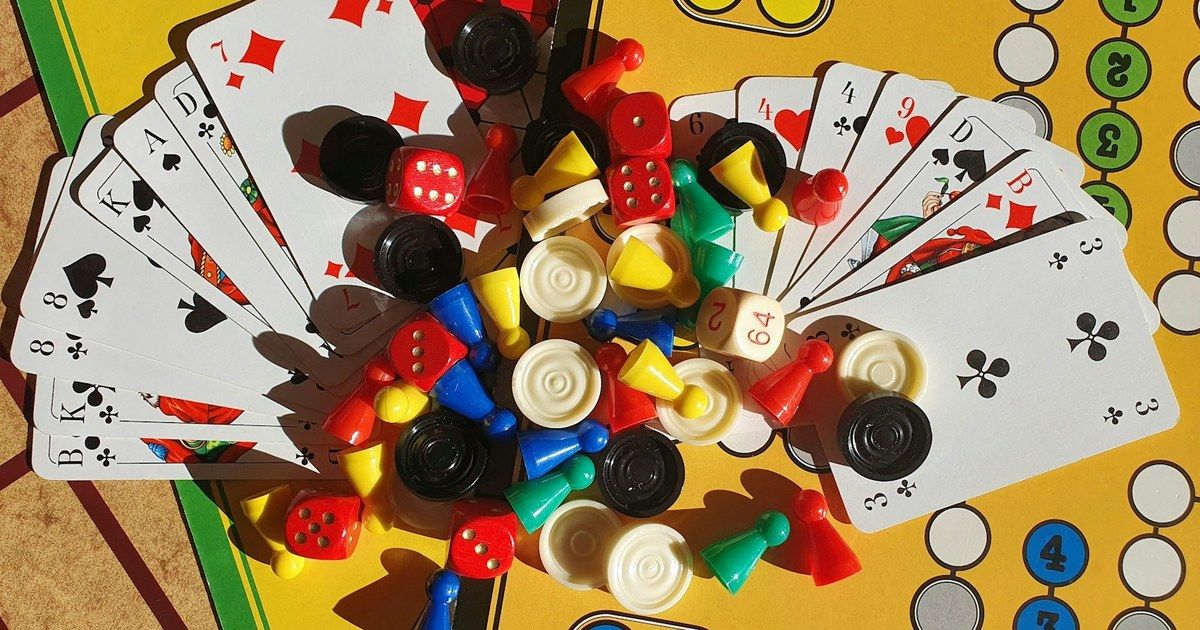
Trash is a layout game in which players replace hidden cards with face-up cards matching numbered positions. Start with ten slots, ace through ten. Win a hand to reduce your next layout by one slot; complete the final single slot to win the game. This guide follows the Bicycle and Pagat main version: jacks are wild, queens and kings end your turn, and a completed layout ends the hand immediately.
What you need
Two players use one standard 52-card deck without jokers. Three or four use two decks together; five or six use three. Leave space for each layout, a stock and an adjacent discard pile.
| Card | Role in the initial layout |
|---|---|
| Ace | Position 1 |
| 2 through 10 | Position matching the printed number |
| Jack | Wild; may fill any face-down position |
| Queen or king | Cannot fill a position; ends the chain |
| Suit or color | Does not affect placement |
There is no high-card contest. A king is not stronger than a jack here: the king is unplayable and the jack can help complete your layout. The poker hand rankings chart applies to a different scoring system, not to deciding what belongs in a Trash slot.
Setup and the deal
Choose the first dealer and opening player by agreement. Deal ten cards face down to each player, without looking at them, and arrange each layout in two rows of five. Number the positions from left to right: 1 through 5 above, then 6 through 10 below.
Put the remaining cards face down as the stock. Do not turn up an opening discard. The first player draws from the stock; their first unplayable card will start the discard pile. Later turns may begin by taking its top card instead.
In the two-player deal, there are 20 layout cards + 32 stock cards = 52. A face-down card is an unfilled position even though a physical card already occupies it. It is not an empty space into which you add a second permanent card.
How a turn works
Draw a card. On the opening turn, use the stock. On later turns, choose the stock or take the top discard if it helps your current layout.
Place a matching number. If its numbered position is still face down, replace that hidden card with the drawn card face up. Pick up the displaced card, reveal it, and try to place it next. Keep chaining in this way while placements remain legal.
Use a jack as a wild. Put it in any position that still has a hidden card. Reveal the displaced card and continue. If the natural number for that position later appears, replace the jack with it and reuse the jack in another face-down position.
Discard when the chain stops. A queen, king, duplicate of an already-filled natural number, or number outside your current layout cannot be placed. Put that card on the discard pile and pass clockwise. You do not draw another card after that discard.
For example, with a natural 6 already face up in slot six, another six ends the chain. With a jack there instead, a six can replace it and release the jack for reuse. The distinction is what occupies the slot, not the suit of the new six.
Scoring and how the game ends
The first player with an appropriate face-up card in every required position wins the hand immediately. Other players do not receive an extra turn in this version. Reshuffle all cards and redeal: only the winner reduces their layout by one; everyone else keeps their previous size. The winner also plays first next hand.
| Personal layout size | Required natural cards | Numbers that no longer fit |
|---|---|---|
| 10 | A through 10 | None |
| 9 | A through 9 | 10 |
| 8 | A through 8 | 9 and 10 |
| 1 | Ace | 2 through 10 |
Continue the same pattern between these checkpoints. A jack remains wild at every layout size. Thus the final one-slot hand can be completed with an ace or jack, not only an ace. The player who completes that hand wins the game; merely reducing from two slots to one has not yet won it.
This is personal progress, not a shared round counter. If Ana wins twice and Ben has not won, their next layouts contain eight and ten cards respectively. Ana cannot place a nine or ten even though Ben still needs both.
If the stock is exhausted before a layout is complete, leave the top discard visible, shuffle the other discards and use them as the new stock. Keep the layouts as they stand; an empty stock does not award a hand win or reset progress.
A worked example
Ana and Ben begin a two-player, ten-slot hand. Ana is the agreed opening player. Her layout is hidden, and the first stock card she draws is 4♠.
- Ana places 4♠ into slot four and reveals the displaced 7♦.
- She puts 7♦ into slot seven and reveals J♣.
- She uses J♣ as an ace in slot one and reveals 2♥.
- She puts 2♥ into slot two and reveals Q♠.
- The queen is unplayable, so she discards Q♠ and ends her turn.
Her face-up positions are now 1: J♣, 2: 2♥, 4: 4♠, 7: 7♦. Six positions remain face down. She still has exactly ten layout cards: four replacements changed their visibility, not the layout’s size.
Ben cannot use the discarded queen, so he draws 9♣ from the stock. He puts it into slot nine and reveals 4♦, which goes into slot four. That reveals 9♥. His ninth slot already contains a natural nine, so he discards 9♥. His turn ends with two face-up positions and eight hidden ones.
For a separate wild-replacement illustration, suppose Ana later draws A♦ while her J♣ still occupies slot one and slot three remains face down. A♦ replaces J♣; she may then put the released jack into slot three and continue with its displaced card. She does not take an extra stock draw between those moves.
Where rules can differ
Pagat lists a kings-wild alternative in which jacks and queens are unplayable. It also describes shorter matches and extra chances for losing players. None of those alternatives changes the main rules selected here: jacks alone are wild, and the first completed layout ends the hand.
For a different matching game, see Crazy Eights. Further reference pages are collected in the chart directory.
FAQ
Can you inspect the hidden cards before choosing a slot?
No. Reveal a hidden card only when a legal placement displaces it. Do not search the layout for a useful card or rearrange hidden cards after seeing them.
Can a king fill any slot?
No, not in this version. A king ends your chain just like a queen. Only jacks are wild.
What happens after a player wins the ten-slot hand?
That player receives nine layout cards next hand, covering A through 9, and plays first. The other players retain their own current layout sizes.
Can a jack win the final one-slot hand?
Yes. Either an ace or a jack fills that last required position. A number from 2 through 10, a queen or a king cannot do so.
Sources
- Bicycle: Trash, the main jacks-wild rules and shrinking-layout match used here.
- Pagat: Trash, confirmation of the same main rules, stock recycling and separately labeled alternatives.