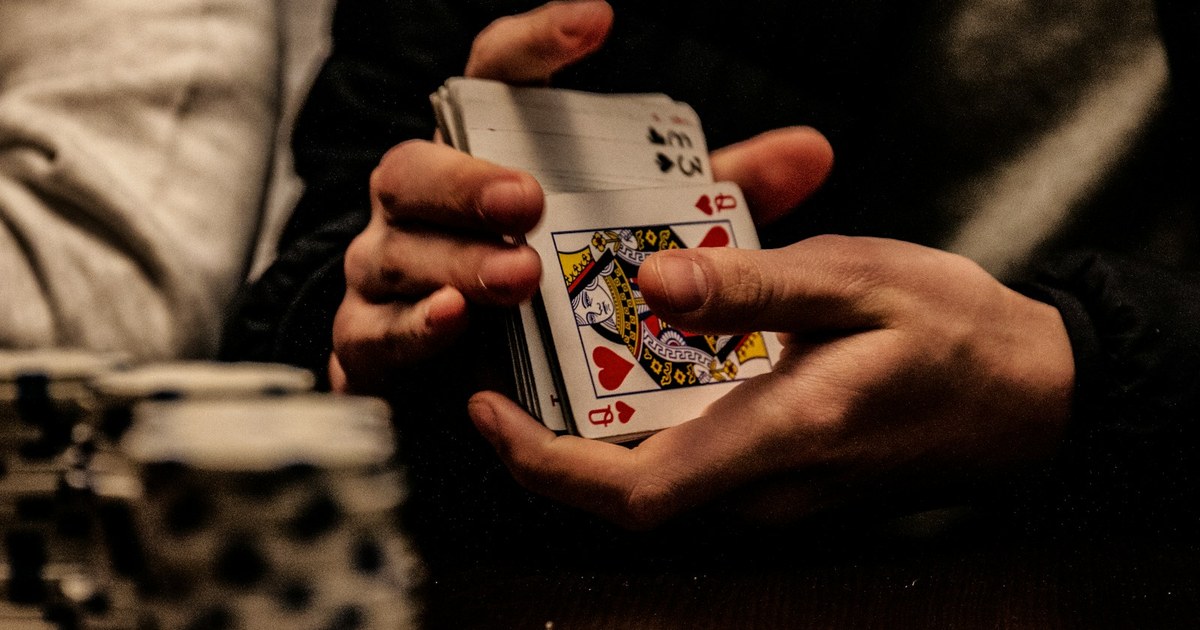
Gin Rummy is a two-player, 10-card game of forming sets and runs while reducing unmatched cards, called deadwood. You may end a hand by knocking with 10 or fewer deadwood points after your discard. This guide follows Pagat’s main version, using a 20-point gin bonus and a 10-point undercut bonus. Those amounts matter: rules using 25-point bonuses produce different scores.
What you need
Use a standard 52-card deck without jokers and a score sheet. Melds stay in your hand during normal play, unlike the exposed combinations in Basic Rummy.
| Cards | Sequence position | Deadwood value |
|---|---|---|
| Ace | Low, before 2 | 1 |
| 2 through 10 | Numerical order | Printed number |
| J, Q, K | After 10, in that order | 10 each |
A set contains three or four equal ranks. A run contains three or more consecutive cards of one suit. Each physical card can belong to only one meld when you count the hand. A♥ 2♥ 3♥ is valid; Q♥ K♥ A♥ is not.
For practice, sort melds slightly apart from loose cards without revealing them. Then count the loose cards by value, not just by how many there are. One king is 10 deadwood; three aces would form a set and contribute none.
Two players use one standard 52-card deck with no jokers. The hand is private: players organize their own cards, while the discard pile is public. Keep a pencil and score sheet nearby if you are playing a match, because the winner of a hand does not necessarily win the game. A tally should record hand points as they are awarded, then any match bonuses when someone reaches the agreed target.
If you play with more than two people, agree on the exact variant first. A common three-player arrangement has one dealer sit out while the other two play, and the loser of one hand deals the next hand with the previous dealer. This is not a three-person hand in which everyone receives cards and competes simultaneously. The two-player rules below remain the baseline; the variation section describes what changes.
Rank of cards and point values
Card rank and deadwood value are related, but they answer different questions. Rank determines which cards can form a run. Deadwood value determines how many unmatched points a player holds when a hand ends. Aces are low in this version, so A-2-3 of one suit is a run, while Q-K-A and K-A-2 are not. You can make a set from three or four cards of one rank, regardless of suit, but you cannot use the same physical card in two melds.
| Card | Rank in a run | Deadwood value |
|---|---|---|
| Ace | Low, before 2 | 1 |
| 2 through 10 | Numeric order | Face value |
| Jack | After 10 | 10 |
| Queen | After Jack | 10 |
| King | After Queen | 10 |
The face-card column is a common source of arithmetic errors. A queen counts as 10 deadwood, not 12; a king counts as 10, not 13. A set of three queens is a meld and counts as zero deadwood, but a lone queen is worth ten. A player does not score the printed card value of melded cards when comparing deadwood. Only unmatched cards count.
Melds: sets and runs
A meld is a legal group of at least three cards. There are two types. A set contains three or four cards of the same rank, such as 6♣ 6♦ 6♥. A run contains three or more consecutive cards of one suit, such as 4♠ 5♠ 6♠ 7♠. A two-card pair or sequence is not a meld yet, even if it looks close to completion.
The suit requirement matters for runs. 7♥ 8♥ 9♥ is a run; 7♥ 8♣ 9♥ is not. The ranks must also be consecutive: 7♥ 8♥ 10♥ skips a rank and does not qualify. A run may be longer than three cards, so 3♦ 4♦ 5♦ 6♦ 7♦ is one five-card meld. You may not count 3♦ 4♦ 5♦ and 5♦ 6♦ 7♦ as two separate runs because the 5♦ would be used twice.
Sets work differently. Three jacks can form a set, as can four jacks, but a fifth card cannot join because a standard deck has only four suits and one card of each rank and suit. In a normal 52-card deck, the four cards of a rank are physically distinct. The card cannot simultaneously belong to a set and a run. If your hand contains 4♣ 5♣ 6♣ plus 6♦ 6♥, you must decide whether 6♣ belongs to the club run or to a set of sixes. You cannot claim both melds at once.
When evaluating a hand, look for the arrangement that leaves the fewest deadwood points, not merely the greatest number of melds. A longer run may absorb cards that could otherwise form a set, or one card may link two possible runs. Lay the cards out privately, count each card once, then add only the ungrouped values. You can keep incomplete combinations in your hand while you draw, but they are not melds for scoring until they contain at least three legal cards.
Knocking, ginning and undercutting
After drawing and then discarding, count the deadwood in the ten-card hand that remains. Under this article’s standard version, a player may knock if that total is 10 or less. The player discards one card face up, announces the knock, and shows the hand arranged into melds and unmatched cards. Knocking ends the hand; the opponent reveals their cards, and deadwood is compared after any legal layoffs.
The discard is part of the turn. Normally you draw one card, then discard one. You cannot take the top discard and immediately put that exact card back on top as your discard. If the card you drew from the stock does not help, you may discard it. The knock threshold applies after the discard, not to an eleven-card hand between drawing and discarding. If you have 11 deadwood before discarding, you may discard a 10-point card and knock with 1, provided the resulting hand has a legal arrangement of melds and unmatched cards.
To go gin, all ten cards after the discard must be covered by valid melds, leaving zero deadwood. You do not have to knock with zero; you announce gin instead. The opponent cannot lay off cards after gin under the selected Pagat rules. Gin is worth a bonus in addition to the opponent’s deadwood. Some games allow a separate Big Gin declaration when all eleven cards after drawing form melds, before discarding. That is a distinct optional rule and is not used in the examples here.
After an ordinary knock, the defender shows their melds and may lay off unmatched cards onto the knocker’s exposed melds. A layoff extends a legal meld without changing its basic form. If the knocker has 5♣ 6♣ 7♣, the defender may lay 4♣ or 8♣ onto that run. If the knocker has three queens, the defender may add the fourth queen. The defender cannot lay off a card onto their own meld to reduce deadwood, cannot create a new meld from the knocker’s cards, and cannot split or rearrange a meld already shown by the knocker. Layoff rules vary across rule sets, so the table should agree before play.
The defender’s final deadwood after layoffs is compared with the knocker’s. If the knocker has fewer points, the knocker scores the difference. If the defender has fewer or equal points, the defender undercuts the knocker and scores the difference plus the undercut bonus. Under the selected schedule, a tie still gives the defender the 10-point bonus. If the defender has a card that could legally extend a knocker’s meld, it should be laid off before comparing deadwood; missing a legal layoff can change both who scores and how much.
When to knock: a decision guide
Meeting the limit gives you permission to knock, not a command. Compare your deadwood after discarding, the opponent’s likely total, possible layoffs and the value of one more draw. The opponent’s hand is hidden, so the discard pile is evidence, not certainty.
Calculate the final ten cards. Pairs are not melds. If the unmatched cards are A♦, 4♣ and 5♠, their deadwood is 1 + 4 + 5 = 10. Recount after choosing the discard because it can change which non-overlapping groups you can make.
Check what the defender can lay off. A 2♥ or 6♥ can extend a shown 3♥ 4♥ 5♥ run. A knock that appears to win by three points may become an undercut if one such card is held. Consider likely extensions, but do not assume the opponent has them.
Compare knocking with waiting. If you knock at 8 and estimate the opponent has 20 deadwood, the basic difference would be 12. Waiting for gin could add a bonus and their full deadwood, but the opponent may knock first and your next draw may miss. If you are one card from gin, count only unseen cards that complete a valid meld and consider the value of the discard you would have to give up.
Use the match score. A small safe lead may matter when an opponent is near 100; a player far behind may value a higher-variance route. Neither situation creates a guaranteed result. Practice by noting your estimate before revealing the opponent’s hand, then compare it with the actual deadwood and layoffs. The sources below describe the published base rules; agree on house differences before playing.
Setup
Draw cards to choose the first dealer: lower card deals. Give each player ten cards, expose the next card as the discard and leave 31 in the stock. In the selected version, the winner of a scored hand deals the next one.
The opening upcard has a special procedure. The non-dealer may take it. If they decline, the dealer may take it. If both decline, the non-dealer draws from the stock. Whoever takes a card completes that turn with a discard, then the other player acts.
This opening offer does not give either player a free extra card. Once someone has drawn and discarded, both players again have ten.
How a turn works
Draw the top stock card or top discard. Then discard one card, leaving ten. You cannot take the visible discard and immediately put that identical card back, though a newly drawn stock card can be discarded.
Before discarding, check whether the resulting ten-card hand permits a knock. If you choose to knock, discard face down and expose your hand in melds and deadwood. Knocking is optional; meeting the limit does not force you to stop.
After an ordinary knock, your opponent exposes their hand and may lay unmatched cards onto your melds. They cannot add to your deadwood, and you cannot lay off onto their melds. After gin, which means no deadwood, the opponent gets no layoffs in this version.
Think of laying off as extending an existing legal shape. If the knocker shows 5♣ 6♣ 7♣, an opponent’s 8♣ can attach. An unrelated 8♦ cannot. A third five cannot join two fives that the knocker counted as unmatched cards.
Scoring, all cases
The values below follow the selected Pagat schedule: 20-point gin bonus, 10-point undercut bonus, 100-point game bonus, 200 instead of 100 for a shutout, plus 20 points for each hand won. Gin Rummy scoring differs by table and by published rules. Some games use a 25-point gin bonus, a different undercut bonus, a different match target or a different shutout calculation. Agree on one system before dealing and do not mix values from two columns of a score sheet.
| Hand ending | Who scores | Calculation in the selected version |
|---|---|---|
| Ordinary knock, knocker has less deadwood | Knocker | Opponent’s final deadwood minus knocker’s final deadwood |
| Undercut, defender has less deadwood | Defender | Knocker’s deadwood minus defender’s deadwood, plus 10 |
| Tie after a knock | Defender | 0 difference plus 10 undercut bonus |
| Gin | Player going gin | Opponent’s full deadwood plus 20; no layoff |
| Hand ends with no score | Nobody | No hand points; same dealer redeals in this version |
| Match reaches 100 | Match winner | Add the 100 game bonus and 20 per hand won, under this score sheet |
| Shutout at match end | Match winner | The game bonus is 200 instead of 100 if the opponent scored no hand points |
| Alternative shutout schedule | Match winner | Some tables award a separate 250-point shutout bonus; this is not the selected Pagat base schedule |
Deadwood means only unmatched cards. After an ordinary knock, the defender’s layoff cards reduce their deadwood before the calculation. The difference is never negative for the player who scores it. For example, if a knocker has 7 and the defender has 5 after laying off, the defender scores 7 - 5 + 10 = 12. If the knocker has 4 and the defender has 16, the knocker scores 16 - 4 = 12. A tie is an undercut, so the defender receives 10 in this schedule even though the difference is zero.
For gin, the player going gin scores the opponent’s whole deadwood plus the gin bonus. If the opponent has 17 deadwood and the gin bonus is 20, the hand score is 17 + 20 = 37. There are no layoffs after gin in the selected rules. Do not subtract the gin player’s deadwood; it is zero by definition.
When one player reaches or passes 100 hand points, the match ends after the hand is scored. Under Pagat’s score sheet, the match winner adds a 100-point game bonus and 20 points for each hand won, while a shutout changes the game bonus to 200. The brief’s sample of a 250-point sweep is a different schedule. Some score sheets use 250 or award a separate shutout amount, so state the chosen rule instead of presenting one value as universal. Match bonuses are added after the target is reached; they do not affect whether the player reached 100 during a hand.
In the selected stock rule, if the player who draws the third-last stock card completes a discard without knocking, the hand is cancelled with no score and the same dealer redeals. Two stock cards remain unused. This is one of the details that distinguishes Gin from draw-and-discard Rummy, where a group may recycle discards. Check the house rules before play because stock endings and red deals can differ.
Three worked hands
The examples use the 20-point gin and 10-point undercut schedule above. Cards separated by slashes show proposed melds; cards after the final slash are deadwood. Every card is counted once. A draw temporarily gives the player eleven cards, but the hand returns to ten after the discard. The listed opponent cards are the revealed cards at the ending, not information the player knew while deciding.
Hand 1: A beginner learns to draw, sort and count
Alice’s ten-card starting hand is 3♥ 4♥ / 8♣ 8♦ 8♠ / 5♣ 6♣ / K♦ Q♠ / 2♥. The first upcard is 7♣. She takes it because it extends 5♣ 6♣ into a three-card run. After taking the upcard, she has eleven cards. Her best visible groups are the three eights and 5♣ 6♣ 7♣. That covers six cards. The remaining 3♥ 4♥ K♦ Q♠ 2♥ total 3 + 4 + 10 + 10 + 2 = 29 deadwood before she discards.
Alice discards Q♠. Her ten-card hand now has the same two melds plus 3♥ 4♥ K♦ 2♥, for 3 + 4 + 10 + 2 = 19 deadwood. She cannot knock yet. This is also a useful reminder that two hearts in a row are not yet a meld: 2♥ 3♥ 4♥ would qualify, but 3♥ 4♥ alone does not.
On her next turn, Alice draws 2♣ from the stock. Her eleven cards can now be grouped as 2♥ 3♥ 4♥ / 8♣ 8♦ 8♠ / 5♣ 6♣ 7♣, with K♦ 2♣ left over. Those two unmatched cards are worth 10 + 2 = 12. She discards K♦, reducing the post-discard hand to ten cards with three melds and only 2♣ deadwood. Her deadwood is now 2, below the knock limit of 10, so she may knock.
Ben reveals 5♦ 5♥ 5♠ / 9♥ 10♥ J♥ / 2♠ 3♠ 4♠ / K♣. His three melds cover nine cards; K♣ is 10 deadwood. He cannot lay off any card onto Alice’s hearts 2-3-4, clubs 5-6-7 or set of eights. The final comparison is Alice 2 against Ben 10. Alice scores 10 - 2 = 8 points. The first turn’s 19 deadwood was not a legal knock; the second turn’s 2 deadwood was. This distinction helps a beginner track how drawing and discarding changes the hand instead of treating a promising two-card combination as a finished meld.
Hand 2: A knock is undercut after layoffs
Ben knocks with 4♣ 5♣ 6♣ / 9♦ 9♥ 9♠ / A♥ 2♥ 3♥ / K♦. The first three groups are legal melds and cover nine cards. K♦ is the sole deadwood card, worth 10, so the knock is legal. He shows the hand and declares the knock.
Alice reveals 7♣ 9♣ / 10♦ J♦ Q♦ K♠ / 3♣ 3♦ 3♠ / 2♠. The diamond run and set of threes cover seven cards. Before layoffs, she has 7♣ 9♣ 2♠, worth 7 + 9 + 2 = 18 deadwood. She can legally lay 7♣ onto Ben’s 4♣ 5♣ 6♣ run, making 4♣ through 7♣. She can also add 9♣ to Ben’s set of three nines, making four of a kind. These two plays reduce her deadwood to just 2♠, or 2 points.
Now compare Ben’s 10 with Alice’s 2. Alice has fewer deadwood points, so Ben is undercut. The difference is 10 - 2 = 8; add the 10-point undercut bonus. Alice scores 8 + 10 = 18. Had she failed to lay off the seven and nine, her deadwood would incorrectly appear to be 18 and the score would be wrong. Layoffs happen before the comparison, and they can turn an apparent knock win into an undercut.
This example also shows why a knocker should inspect the exposed shape before ending the hand. Ben’s 4-5-6 run was easy for a 7♣ to extend, and his three nines were vulnerable to the fourth nine. The player deciding whether to knock cannot see Alice’s actual cards, but can list these possible extensions and consider how many could plausibly remain unseen. No estimate can guarantee the result; the scoring rule, however, is mechanical once hands are revealed.
Hand 3: A short match from zero to 100, with two gins
The following mini-match starts at 0-0 and uses the same 20/10 hand bonuses. It demonstrates several different endings and then follows the cumulative hand score until Alice reaches the 100-point target. Match bonuses are added only after the final hand.
Deal one, Alice knocks for 8. Use the cards from Hand 1. Alice knocks with 2 deadwood. Ben exposes his hand with 10 deadwood and no legal layoff. Alice wins the difference, 10 - 2 = 8. Running hand score: Alice 8, Ben 0.
Deal two, Alice is undercut for 18. Use the cards from Hand 2, with Ben knocking at 10 and Alice laying off 7♣ and 9♣ to finish at 2. Alice scores 10 - 2 + 10 = 18. Running hand score: Alice 8 + 18 = 26, Ben 0. The player who knocks does not automatically score; the defender can win the hand.
Deal three, Alice goes gin for 42. Alice’s ten cards are 4♥ 5♥ 6♥ 7♥ / 8♣ 8♦ 8♠ / 10♠ J♠ Q♠. The four-card heart run, set of eights and three-card spade run cover all ten cards, so Alice has zero deadwood and declares gin. Ben reveals 3♦ 4♦ 5♦ / 9♣ 9♦ 9♥ / K♠ Q♣ A♦ A♣. His melds cover six cards; the four unmatched cards total 10 + 10 + 1 + 1 = 22. Alice scores 22 + 20 = 42. Running hand score: Alice 26 + 42 = 68, Ben 0. The deadwood is not reduced by layoffs after gin.
Deal four, Alice goes gin again for 34. Alice’s hand is A♠ 2♠ 3♠ 4♠ / 5♣ 5♦ 5♥ / J♥ Q♥ K♥. All ten cards form three melds. Ben reveals 6♣ 7♣ 8♣ / 9♠ 9♦ 9♥ / K♦ A♦ A♣ 2♦. He has two melds, leaving K♦, A♦, A♣ and 2♦ as deadwood: 10 + 1 + 1 + 2 = 14. Alice scores 14 + 20 = 34. Her cumulative hand points are 68 + 34 = 102, so she has passed the 100-point game target. Both gins have been scored from the opponent’s full deadwood plus the 20-point bonus.
Under the selected Pagat match schedule, Alice then adds 20 points for each of her four hands won, or 4 × 20 = 80, plus the 200-point shutout game bonus because Ben scored no hand points. Her final match total is 102 + 80 + 200 = 382; Ben has zero. If a group uses a separate 250-point sweep bonus instead, the final tally changes. Agree on that rule before the first deal. This match illustration deliberately separates hand points from end-of-game bonuses so the 100-point trigger is not counted twice.
Gin Rummy and other Rummy games
Rummy is a family name for games in which players form combinations and draw and discard cards. Gin Rummy is one member of that family, with a distinctive two-player structure: each player receives ten cards, melds remain concealed during play, and a player may end an ordinary hand by knocking at a permitted deadwood count. Going gin means all ten cards form melds. The score comes from the opponent’s deadwood, the difference after a knock, and bonuses specified by the chosen rules.
Basic Rummy works differently. Players usually expose melds during play and try to empty their hands. Depending on the version, they may lay off on any exposed meld, and the scoring can count cards remaining in opponents’ hands. Our Basic Rummy rules currently explain a specific draw-and-discard game with visible melds; use that page for those rules, not for Gin’s hidden-hand knock procedure. The two games share sets and same-suit runs, but those common shapes do not make the games interchangeable.
Indian Rummy, often called 13-card Rummy or Paplu, is another branch. Published versions commonly deal 13 cards to each player, may use two decks and jokers, and require a valid declaration with at least two sequences, including a pure sequence without a joker. Exact player counts, points, joker handling and drop penalties vary by platform and table. The Gin rule of knocking at ten deadwood does not apply. A Gin player can knock with unmatched cards; an Indian Rummy player generally needs to arrange the required hand before declaring.
500 Rum, also called Rummy 500, uses exposed melds and awards points for cards a player melds or lays off. Players may have rules allowing them to take a deeper discard by also taking the cards above it, with conditions about melding the selected card. The goal is commonly to reach 500 points, not to knock at a deadwood threshold. Canasta is another Rummy-family game with its own team play, multiple decks, wild cards and meld requirements. These names describe different rule systems, not a ladder of difficulty.
When someone says “Rummy,” ask which game they mean. The number of cards dealt, whether combinations are exposed, how aces work, whether jokers are included, and how a hand ends can all change. A rule copied from one variant can produce an invalid move in another. The concise comparison is: Gin Rummy keeps melds hidden and uses knocks; Basic Rummy exposes melds and races to go out; Indian Rummy requires a structured 13-card declaration; 500 Rum scores exposed cards toward a target. Set up the correct rules before the deal rather than importing a familiar rule by habit.
Variations to know before playing
The following variants change a specific part of the base game. They are not extra steps that every Gin player must combine. Choose one rule set at a time and state the difference before dealing.
Oklahoma Gin
Oklahoma Gin uses the first face-up card to set the maximum deadwood count allowed for an ordinary knock. If the upcard is a 7, a player generally needs 7 or fewer deadwood, rather than the standard ten. Face cards count as ten for this limit. In a common Oklahoma rule, if that first upcard is a spade, the score for the hand is doubled, including the gin or undercut bonus. The match target is often 150 points rather than 100. These conditions create a hand-specific knock threshold, so record the original upcard and its suit before play begins. Some tables alter the ace rule or omit the doubling; do not assume every Oklahoma game uses identical settings.
Straight Gin
Straight Gin removes ordinary knocks. A player cannot end a hand with unmatched cards at or below ten; they must make gin with all ten cards melded. This changes the pace and the risk of holding high deadwood. A hand can continue after a player reaches a small unmatched total, because that player has not completed every card into a meld. Agree on how the stock ending works and whether a Big Gin bonus is available, as these details can vary. Straight Gin is not simply standard Gin played more carefully: the knock option itself is absent.
500 Rum
500 Rum is a different Rummy game, not a Gin scoring option. Its melds are usually placed face up as play progresses, and players score for cards melded or laid off. A player may be allowed to pick up part of the discard pile, sometimes including all cards above a selected card, if they can meld that selected card immediately. Players continue hands until a score target, commonly 500, is reached. Deck size, joker use, card values and the exact discard-pickup rule should come from the table’s selected rule sheet. The Gin knock limit, undercut bonus and hidden melds do not carry over.
Three-player Gin Rummy
A common three-person format has the dealer sit out each hand while the other two play. The loser deals the next hand, which is played by the previous winner and the new dealer. This rotates who participates and who deals; it is not the same as three players each receiving ten cards and competing in one hand. Other local formats exist, so specify who sits out and how dealer rotation works. Keep separate running scores for all three people, and agree whether a non-playing dealer receives any role beyond dealing. The basic scoring examples in this article assume two active players only.
Other scoring and hand options
Many groups use a 25-point gin bonus instead of 20, or a 20- or 25-point undercut bonus instead of ten. Big Gin may receive 31, 50 or another bonus. Some rule sheets double the match winner’s points for a shutout; some add a fixed game bonus instead. A game might end at 100, 150 or 250. These are score-sheet options, not universal Gin constants. Keep the chosen numbers written down so a player does not use 25 for a gin and 10 for an undercut by accidentally merging two versions.
Eight mistakes beginners make
1. Saving pairs and forgetting the deadwood total
The mistake: Treating pairs or two-card sequences as melds. Why it is wrong: Only groups of three or more remove cards from deadwood. A pair of twos still counts four points. Do this instead: Arrange ten cards into non-overlapping melds, list each unmatched card, then add values after choosing the discard.
2. Chasing gin when a safe knock is available
The mistake: Passing a low-deadwood knock for several turns to chase gin. Why it is wrong: The opponent may end the hand first, and another draw can increase your deadwood. Do this instead: Compare likely knock points, the gin bonus, visible pickups and match score. Waiting carries risk.
3. Knocking early without considering an undercut
The mistake: Knocking at ten just because it is legal. Why it is wrong: A defender at four scores 10 - 4 + 10 = 16; a tie also undercuts. Do this instead: Check which cards could extend your exposed melds and account for likely layoffs.
4. Ignoring the opponent’s discards and pickups
The mistake: Forgetting which discards the opponent took. Why it is wrong: An 8♥ pickup may connect to a heart run or a set of eights. Do this instead: Track pickups and avoid an obvious extension when another discard is similarly safe. Treat clues as uncertain.
5. Letting an ace run through the king
The mistake: Using Q-K-A or K-A-2 as a run. Why it is wrong: Ace is low here and cannot wrap around. Do this instead: Place it before 2 unless the table explicitly agrees another rule.
6. Miscounting layoffs
The mistake: Comparing deadwood before layoffs. Why it is wrong: A legal 7♣ extends 4♣ 5♣ 6♣ and removes seven points. Do this instead: Test unmatched cards against the knocker’s melds, apply legal extensions, then total the rest. Do not lay off onto your own melds here.
7. Giving face cards the wrong value
The mistake: Counting a king as 13 or queen as 12. Why it is wrong: Face cards each count ten deadwood; ace counts one. Do this instead: Use number-card values for 2-10, ten for J/Q/K and one for ace. Melded cards count zero.
8. Keeping disconnected high cards at the start
The mistake: Keeping K♣, Q♦ and J♥ because they are high ranks. Why it is wrong: Unmatched, they carry 30 points and do not form a suited run. Do this instead: Prefer plausible connections and consider discarding isolated high cards. It is a heuristic, not an automatic rule.
Printable quick reference
Use this compact card to remember the selected base rules. It deliberately shows the version used on this page; if your table uses 25-point bonuses, Oklahoma Gin or another knock limit, write those changes beside it before dealing.
| At a glance | Selected rule |
|---|---|
| Players and deck | 2 players, one 52-card deck, no jokers |
| Cards dealt | 10 to each player |
| Goal | Reach 100 match points; finish with the selected match bonuses |
| Melds | Set: 3 or 4 equal ranks. Run: 3+ consecutive cards in one suit |
| Deadwood values | Ace 1; 2-10 face value; J/Q/K 10 each |
| Turn | Draw one, discard one; do not immediately return the same visible discard |
| Knock | After discarding, 10 or fewer deadwood |
| Gin | All ten cards melded; score opponent deadwood + 20; no layoffs |
| Ordinary knock win | Opponent’s post-layoff deadwood minus knocker’s |
| Undercut | Defender has equal or lower deadwood; difference + 10 to defender |
| Layoffs | Defender may extend knocker’s melds after an ordinary knock |
| Main caution | Count every card once; a shared card cannot belong to two melds |
Before playing, confirm the game target, gin bonus, undercut bonus, shutout schedule, Oklahoma rule and stock ending. The words “standard Gin” do not guarantee every app, score pad or household uses the same options.
FAQ
Can you knock with exactly 10 deadwood?
Yes. The limit is 10 or fewer after discarding, not strictly below 10. Equality with the opponent’s final deadwood still causes an undercut.
Can your opponent lay off after you go gin?
No, under the selected Pagat rules. This is a material difference from an ordinary knock.
Can you use an ace after a king?
No. Aces are low here, so a sequence cannot turn the corner through K-A-2.
Is the gin bonus 20 or 25?
This guide uses 20. Twenty-five appears in other versions; agree on the bonus sheet before playing and use it consistently.
Is Gin Rummy the same as Indian Rummy?
No. This Gin guide uses two players, ten cards each, hidden melds and a knock limit. Indian Rummy commonly uses thirteen cards and a declaration that requires at least one pure sequence. Jokers, player counts, scoring and details vary by Indian Rummy version.
Does the player who knocks always score?
No. The defender may lay off after an ordinary knock. If their final deadwood is lower than or equal to the knocker’s, the defender undercuts and scores the difference plus the chosen undercut bonus. Gin does not allow layoffs under the rules used here.
Sources
- Pagat: Gin Rummy, the selected opening procedure, knock rules, layoffs and 20/10 bonus schedule.
- Pagat: Gin Rummy and Variations, Oklahoma Gin and related Gin variants.
- Cool Old Games: Straight Gin, comparison reference for the no-knock variant.
- Pagat: Indian Rummy, the 13-card variant, pure sequence and related rules.
- Pagat: 500 Rum, exposed melds, draw rules and target scoring.
- Bicycle: Gin Rummy, a comparison reference. Where details differ, this article explicitly follows Pagat’s selected base version rather than mixing score schedules.