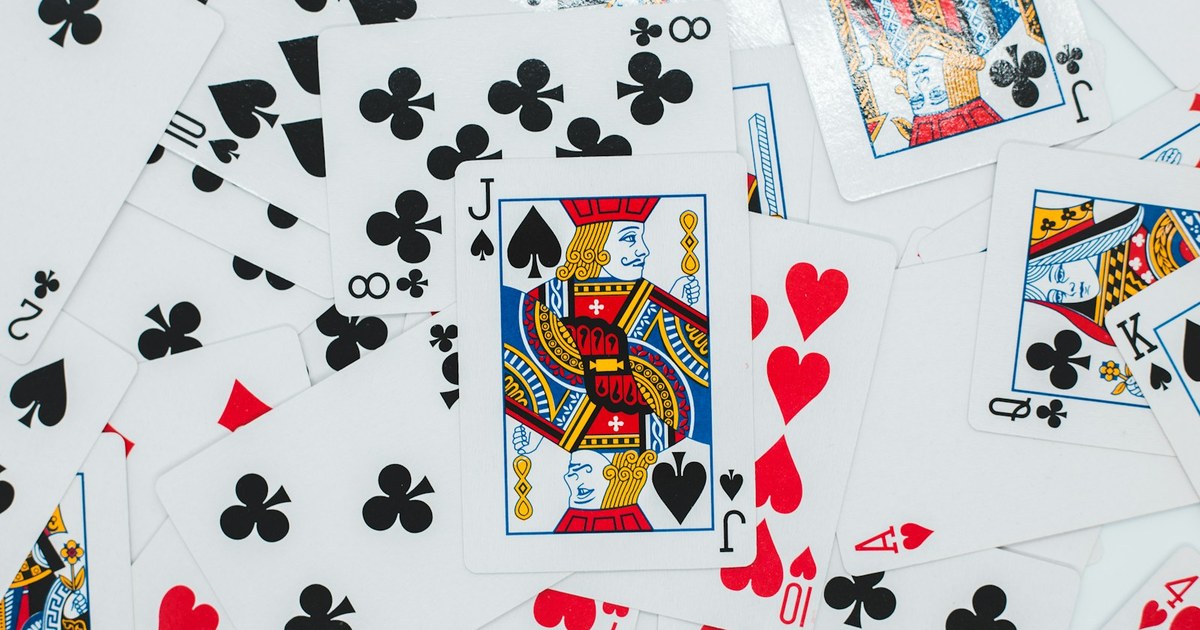
Go Fish is a card-collecting game: ask opponents for ranks you already hold and gather four matching cards into a book. The most books wins, not the first empty hand. This page uses Bicycle’s four-card-book version for two to five players, with play continuing until all 13 books are collected. The worked example uses four players and five cards each.
What you need
Take a standard 52-card deck without jokers. Leave room for a central face-down stock and a separate display of completed books in front of each player. Nobody needs chips or a score target.
| Card feature | Rule in this version |
|---|---|
| Rank order | A, K, Q, J, 10, 9, 8, 7, 6, 5, 4, 3, 2; no high-card contest |
| Same rank | All four suits together make one book |
| Suit or color | Does not change the value of a book |
| Pair | An incomplete collection, not a scored book |
| Any completed book | Worth one book toward the final count |
A book of twos is worth as much as a book of aces. The poker hand rankings chart uses four of a kind in a different scoring system; do not bring its kickers or rank comparisons into Go Fish.
Setup
Choose the dealer by drawing cards, with the lowest dealing. Shuffle, let the player on the dealer’s right cut, and deal clockwise. Give seven cards each with two or three players, or five each with four or five. Put the rest face down as the stock.
The player left of the dealer starts. Keep your hand private and put completed books face up. At a four-player table, 20 cards begin in hands and 32 remain in the stock.
Before the first request, say whether the group is collecting four-card books. A pair-removal game can be enjoyable, but using that rule halfway through this deal would leave players pursuing different objectives.
How a turn works
Choose one opponent and one rank. You must hold a card of that rank yourself. With 6♣ in hand, “Bea, do you have sixes?” is legal. Asking for queens when you hold none is not.
Collect every card of that rank they hold. The opponent cannot give you just one and keep the others. If you receive a card, continue asking. You may change the opponent, the rank, or both, provided your new request is legal.
If they have none, go fish. Draw one card. When it matches the rank you requested, reveal the match and continue your turn. If it is another rank, keep it privately and pass the turn clockwise.
Expose books when completed. Show all four matching ranks and set them aside. They no longer belong to your hand and cannot support later requests. Completing a book does not by itself end your turn.
For example, holding three nines lets you ask for nines, but displaying a completed book of nines does not. All four are already accounted for, so there is no ninth card to obtain from an opponent.
Empty hands, empty stock and winning
An empty hand is not an automatic win. On your turn, if your hand is empty and stock cards remain, draw one and use its rank to make a request. With neither cards nor stock available, you are out of further play and keep the books you earned.
If the stock is empty but you still hold cards, keep asking. A failed request passes the turn without a draw. This continuation is also described among Pagat’s Go Fish variations; it allows the selected all-13-books ending to work after the fishing pile is gone.
Finish when all 13 books have been collected. Count books, not cards held at an earlier point. A final distribution of five, four, three and one books gives the player with five the win. If the highest totals are equal, share the win; this guide adds no suit-based tiebreak.
There is a useful end check: 13 books × 4 cards = 52 cards. If the displayed books contain only 48 cards and someone still holds four, the game has not reached this version’s finish.
A worked example
Here are all four opening hands in one possible deal:
| Player | Five cards |
|---|---|
| Ana | 7♥ 7♦ K♣ 2♣ 9♠ |
| Bea | 7♣ 7♠ Q♥ 4♦ 10♣ |
| Cal | K♥ K♦ 3♣ 5♠ 6♦ |
| Dev | K♠ A♥ A♣ 8♦ J♠ |
Ana starts. She asks Bea for sevens. Bea must hand over both 7♣ and 7♠, giving Ana all four sevens. Ana exposes that book. Her hand is now K♣ 2♣ 9♠.
Because the request succeeded, Ana continues. She asks Cal for kings and receives K♥ K♦. She now has three kings, so she asks Dev for kings. Dev gives K♠, completing Ana’s second book. Ana exposes it, keeping 2♣ and 9♠ in hand.
She next asks Bea for twos. Bea has none and says “Go fish.” Suppose the top stock card is 5♦. Ana draws it, but it is not the requested two. Her turn ends with 2♣ 9♠ 5♦, and Bea acts next.
The complete count is consistent: Ana has three cards, Bea three, Cal three, Dev four, and eight cards are in Ana’s books. That accounts for 21 cards outside the stock, including the one draw. Ana has two books but has not won merely because her turn was productive.
If that last draw had instead been 2♦, Ana would have revealed the matching two and continued asking. A lucky draw is an extra request opportunity, not a completed book unless it supplies the fourth card.
Common mistakes
Address one player at a time rather than asking the whole table. “Does anyone have kings?” gives away information while avoiding the game’s targeted choice. Also listen to requests: they reveal that the asker held the named rank at that moment, though a later completed book may remove it.
For a change of objective, Crazy Eights rewards emptying your hand. Basic Rummy accepts certain three-card combinations that would remain incomplete here. The chart directory contains separate references for other card games and tools.
FAQ
Do you collect pairs or four cards in Go Fish?
Four in this version. Pair-based children’s variants exist, but their shorter collections change when cards leave the hand.
Can you ask for a card you do not have?
No. You need a card of the requested rank in your current hand. A book already displayed does not qualify.
Do you get another turn after drawing the requested rank?
Your current turn continues. Show that matching draw, then make another legal request. Drawing a different rank ends the turn.
Does running out of cards end the game?
No. With stock remaining, refill on your turn as described above. The selected ending is all 13 books collected, not the first empty hand.
Sources
- Bicycle: Go Fish, the four-card books, deal sizes, repeat requests and all-books finish used here.
- Pagat: Go Fish, especially the variations covering continued requests after the stock is exhausted. Its main deal and ending differ from the Bicycle version selected here.