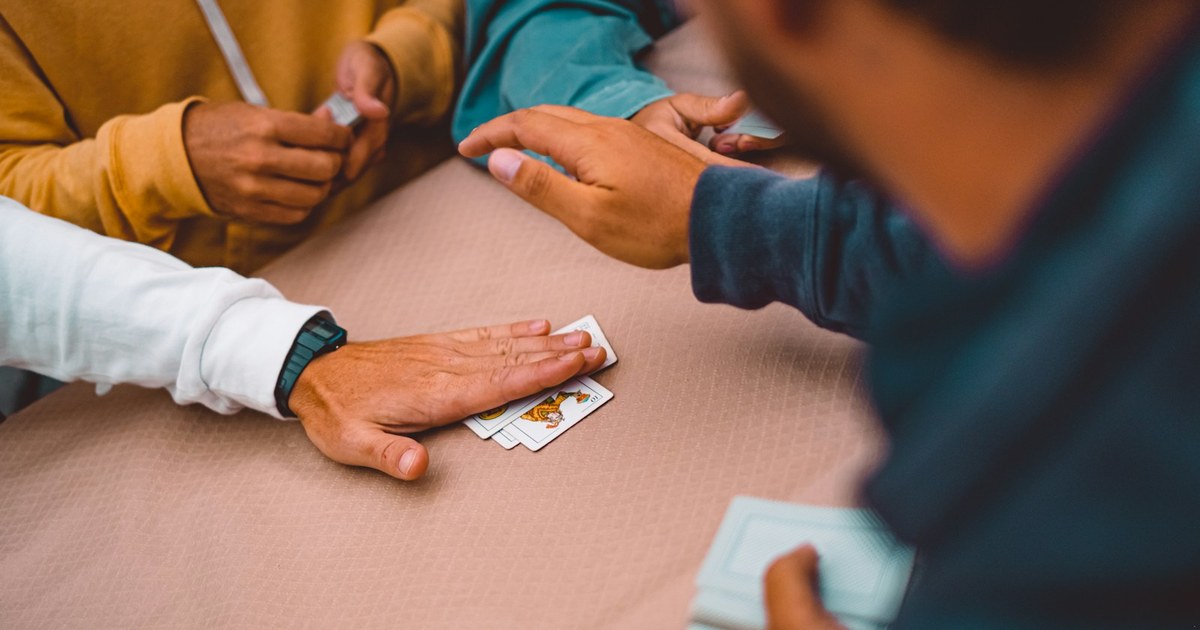
Kings Corners, also called Kings in the Corners, is a shedding game on a shared solitaire-style layout. Build downward in alternating colors and open diagonal piles with kings. This guide uses Pagat’s main version: seven cards each, as many legal moves as you wish, then one draw to end your turn unless you went out. The examples use four players and the king-heavy penalty scoring described below.
What you need
Use one standard 52-card deck without jokers. Four players work well; two or three can use the same deal. Leave space for a stock in the center, four side piles, and four diagonal corner piles.
| Feature | Rule |
|---|---|
| Rank, high to low | K, Q, J, 10, 9, 8, 7, 6, 5, 4, 3, 2, A |
| Red suits | Hearts and diamonds |
| Black suits | Clubs and spades |
| Build direction | One rank lower, opposite color |
| King left in hand | 10 penalty points |
| Any other card left in hand | 1 penalty point |
A red queen fits on a black king. A red jack does not: it skips a rank. Two cards of opposite suits are not necessarily opposite colors, since hearts and diamonds are both red.
Setup
Choose the first dealer randomly. Deal seven cards each, put the remainder face down in the middle, and expose four cards around it at north, east, south and west. Leave the diagonal spaces empty.
At a four-player table, that leaves 28 cards in hands + 4 face up + 20 in stock = 52. Do not deal eight cards to compensate for a king in the opening layout.
The player left of the dealer starts, and turns proceed clockwise. The deal also passes clockwise between hands. Keep each pile overlapped so that its original bottom card and exposed top card can both be identified.
How a turn works
Make any number of legal moves, in any order. You may add hand cards to piles, open corners, combine whole piles and refill vacated side spaces.
Add a hand card. It must be one rank below the destination’s exposed card and the opposite color. On 9♦, either black eight fits. Nothing can follow an ace, because aces are low.
Open a corner with a king. Only a king starts an empty diagonal space. Build down from it normally. A king originally dealt to a side space can also be moved into an empty corner, freeing that side space.
Move a whole pile. Compare the moving pile’s bottom, original card with the destination’s exposed top card. The original card must fit by rank and color. Move the entire pile intact, not a convenient slice from its middle.
Refill a vacated side space. Any hand card can start a north, east, south or west space that a pile move emptied. This freedom does not extend to empty corners.
When you finish playing, draw one card and end your turn. The drawn card must wait until a later turn. If you already emptied your hand, the hand ends immediately and you do not draw.
Scoring and winning
At the end of a hand, count penalties for cards still held. A king costs ten; every other card costs one. The player who went out has zero for that hand.
For a session, agree on a threshold such as 25 before starting. Continue dealing until someone’s cumulative penalties reach or exceed it. The lowest cumulative total then wins. Reaching 25 is a stopping trigger, not a winning target.
For example, if a player’s previous total is 13 and their remaining cards are K♦, Q♣ and A♠, add 10 + 1 + 1 = 12, bringing them to 25. The session now stops. Totals of 9, 16, 21 and 25 give the player on nine the win, regardless of who emptied their hand most recently.
If the stock runs out, continue without drawing. If everyone is unable or unwilling to play, end the blocked hand and count the cards still held by everyone. No player needs to claim a fictional zero-card finish for scoring to proceed.
A worked example
It is Ana’s turn in a later position. A corner is empty. The four side piles are single cards:
| Side | Exposed card |
|---|---|
| North | 5♥ |
| East | 3♣ |
| South | 8♦ |
| West | 6♠ |
Ana’s complete hand is K♣ Q♥ J♠ 10♦ 9♣ 4♠ 2♦.
She opens the empty corner with K♣. On that king she plays Q♥, J♠, 10♦ and 9♣ in order. Every step drops one rank and alternates black, red, black, red, black. Five hand cards have now left her hand.
She puts 4♠ on the north pile’s 5♥, then 2♦ on the east pile’s 3♣. All seven cards are gone: 7 - 5 - 1 - 1 = 0. The hand ends immediately. Ana does not draw a card and accidentally keep the hand alive.
For a separate pile-moving example, suppose one pile is Q♠ J♥ 10♣ from bottom to exposed top. Another pile ends with K♦. The whole first pile fits onto that king because its bottom Q♠ is a black queen following a red king. After the move, 10♣ is still the exposed top. Testing the ten against the king instead would incorrectly reject a legal move.
If the moved pile occupied a side space, Ana could use that newly empty space for any hand card. If it occupied a corner, only another king could restart that space.
Common mistakes and version choices
The biggest practical difference between published versions is when to draw. Bicycle’s current summary draws first; Pagat’s main rules draw last. This article consistently uses draw last, so a freshly drawn king cannot open a corner during that same turn.
Do not confuse this layout with a poker showdown. A poker hand rankings chart compares hands, while Kings Corners tests individual joins. The chart directory has those separate references. For another hand-emptying game with suit matching instead of a layout, see Crazy Eights.
FAQ
How many cards does each player get?
Seven, whether two, three or four players are using this version. The four initial side cards come from the remaining stock.
Can you put a queen in an empty corner?
No. Corners start with kings only. A vacated original side space can start with any hand card.
Can you move just part of a pile?
No. The move described here takes the entire pile, and its bottom card must fit the destination’s exposed top card.
Do you draw if you go out?
No. Emptying your hand ends the hand immediately. Otherwise, the end-of-turn draw happens even if you played several cards first, while stock remains.
Sources
- Pagat: Kings Corners, the selected draw-last rules, whole-pile moves and 10/1 penalty scoring.
- Bicycle: Kings Corner, a comparison reference with a draw-first summary. That alternative is not used in the worked turn.