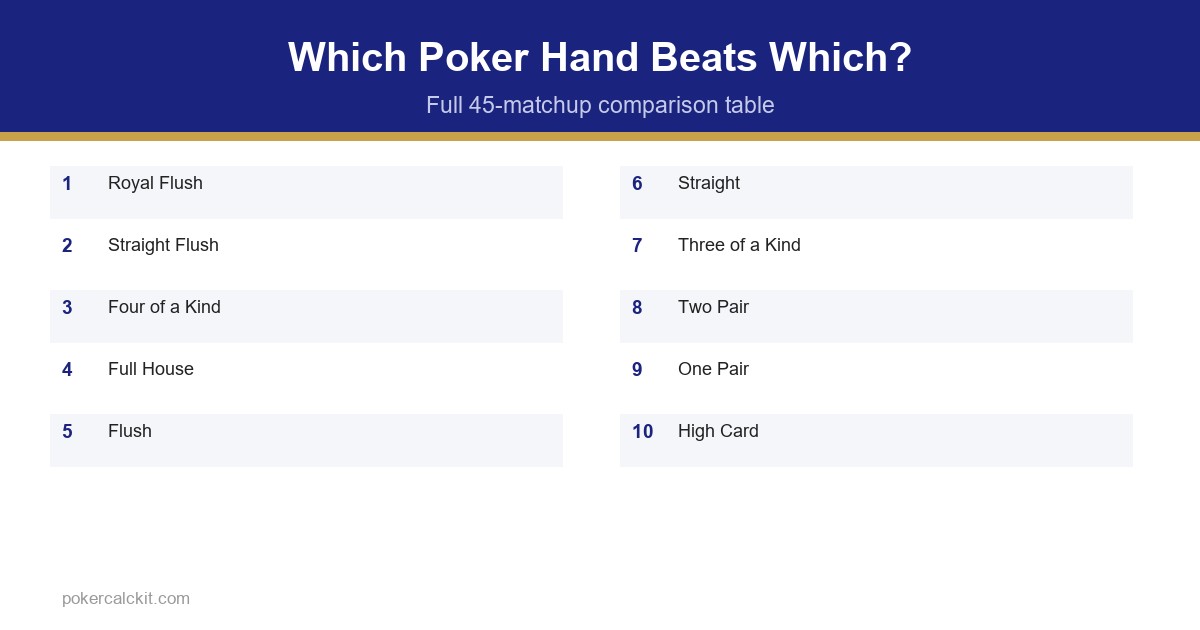
Poker has ten hand types, and the order between them never changes. A royal flush beats a straight flush, a straight flush beats four of a kind, and the same rule runs all the way down to high card. Below are all 45 possible matchups between those ten hand types, so any pair you are unsure about takes one line to answer.
The 10 hands, strongest to weakest
Every hand in poker belongs to one of these ten categories. The example shows one real five-card hand of each type, and the last column gives how often that type appears in a five-card deal from a standard 52-card deck.
| Rank | Hand | Example | Probability |
|---|---|---|---|
| 1 | Royal Flush | A♠ K♠ Q♠ J♠ 10♠ | 0.00015% |
| 2 | Straight Flush | 9♥ 8♥ 7♥ 6♥ 5♥ | 0.0014% |
| 3 | Four of a Kind | Q♠ Q♥ Q♦ Q♣ 7♠ | 0.024% |
| 4 | Full House | J♠ J♥ J♦ 4♣ 4♠ | 0.14% |
| 5 | Flush | A♦ J♦ 8♦ 5♦ 2♦ | 0.20% |
| 6 | Straight | 10♣ 9♦ 8♠ 7♥ 6♣ | 0.39% |
| 7 | Three of a Kind | 8♠ 8♥ 8♦ K♣ 3♠ | 2.1% |
| 8 | Two Pair | A♠ A♥ 9♦ 9♣ J♠ | 4.75% |
| 9 | One Pair | K♠ K♥ A♦ 7♣ 4♠ | 42.3% |
| 10 | High Card | A♠ J♦ 8♣ 5♥ 2♠ | 50.1% |
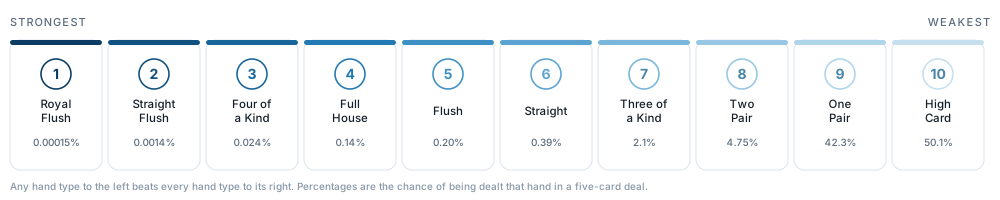
Left to right, the chart runs from the strongest hand to the weakest. Anything to the left beats everything to its right, which is the same relationship the 45-row table below spells out one matchup at a time. Use the chart when you want the whole order at a glance and the table when you need one specific pairing.
The order is not a house rule. It follows rarity: the harder a hand is to make, the higher it ranks, and the ten categories above never swap places in any standard poker variant.
Full comparison: which hand beats which
The table below pairs every hand type against every other type, ordered from the strongest hand down. All 45 combinations are listed, and in each one the hand with the lower rank number wins. The last column shows the two rank positions being compared.
| # | Matchup | Winner | Ranks |
|---|---|---|---|
| 1 | Royal Flush vs Straight Flush | Royal Flush | No. 1 vs No. 2 |
| 2 | Royal Flush vs Four of a Kind | Royal Flush | No. 1 vs No. 3 |
| 3 | Royal Flush vs Full House | Royal Flush | No. 1 vs No. 4 |
| 4 | Royal Flush vs Flush | Royal Flush | No. 1 vs No. 5 |
| 5 | Royal Flush vs Straight | Royal Flush | No. 1 vs No. 6 |
| 6 | Royal Flush vs Three of a Kind | Royal Flush | No. 1 vs No. 7 |
| 7 | Royal Flush vs Two Pair | Royal Flush | No. 1 vs No. 8 |
| 8 | Royal Flush vs One Pair | Royal Flush | No. 1 vs No. 9 |
| 9 | Royal Flush vs High Card | Royal Flush | No. 1 vs No. 10 |
| 10 | Straight Flush vs Four of a Kind | Straight Flush | No. 2 vs No. 3 |
| 11 | Straight Flush vs Full House | Straight Flush | No. 2 vs No. 4 |
| 12 | Straight Flush vs Flush | Straight Flush | No. 2 vs No. 5 |
| 13 | Straight Flush vs Straight | Straight Flush | No. 2 vs No. 6 |
| 14 | Straight Flush vs Three of a Kind | Straight Flush | No. 2 vs No. 7 |
| 15 | Straight Flush vs Two Pair | Straight Flush | No. 2 vs No. 8 |
| 16 | Straight Flush vs One Pair | Straight Flush | No. 2 vs No. 9 |
| 17 | Straight Flush vs High Card | Straight Flush | No. 2 vs No. 10 |
| 18 | Four of a Kind vs Full House | Four of a Kind | No. 3 vs No. 4 |
| 19 | Four of a Kind vs Flush | Four of a Kind | No. 3 vs No. 5 |
| 20 | Four of a Kind vs Straight | Four of a Kind | No. 3 vs No. 6 |
| 21 | Four of a Kind vs Three of a Kind | Four of a Kind | No. 3 vs No. 7 |
| 22 | Four of a Kind vs Two Pair | Four of a Kind | No. 3 vs No. 8 |
| 23 | Four of a Kind vs One Pair | Four of a Kind | No. 3 vs No. 9 |
| 24 | Four of a Kind vs High Card | Four of a Kind | No. 3 vs No. 10 |
| 25 | Full House vs Flush | Full House | No. 4 vs No. 5 |
| 26 | Full House vs Straight | Full House | No. 4 vs No. 6 |
| 27 | Full House vs Three of a Kind | Full House | No. 4 vs No. 7 |
| 28 | Full House vs Two Pair | Full House | No. 4 vs No. 8 |
| 29 | Full House vs One Pair | Full House | No. 4 vs No. 9 |
| 30 | Full House vs High Card | Full House | No. 4 vs No. 10 |
| 31 | Flush vs Straight | Flush | No. 5 vs No. 6 |
| 32 | Flush vs Three of a Kind | Flush | No. 5 vs No. 7 |
| 33 | Flush vs Two Pair | Flush | No. 5 vs No. 8 |
| 34 | Flush vs One Pair | Flush | No. 5 vs No. 9 |
| 35 | Flush vs High Card | Flush | No. 5 vs No. 10 |
| 36 | Straight vs Three of a Kind | Straight | No. 6 vs No. 7 |
| 37 | Straight vs Two Pair | Straight | No. 6 vs No. 8 |
| 38 | Straight vs One Pair | Straight | No. 6 vs No. 9 |
| 39 | Straight vs High Card | Straight | No. 6 vs No. 10 |
| 40 | Three of a Kind vs Two Pair | Three of a Kind | No. 7 vs No. 8 |
| 41 | Three of a Kind vs One Pair | Three of a Kind | No. 7 vs No. 9 |
| 42 | Three of a Kind vs High Card | Three of a Kind | No. 7 vs No. 10 |
| 43 | Two Pair vs One Pair | Two Pair | No. 8 vs No. 9 |
| 44 | Two Pair vs High Card | Two Pair | No. 8 vs No. 10 |
| 45 | One Pair vs High Card | One Pair | No. 9 vs No. 10 |
Royal flush is listed separately from straight flush because most reference tables treat it as its own entry. Strictly speaking it is the highest straight flush, which is why it always wins in row 1 and why nothing below it can ever beat it.
The rankings also hide the matchups beginners lose the most chips to. Pocket aces against suited connectors looks lopsided on the chart, yet the connector side picks up equity on many boards; the full breakdown is in aces vs suited connectors.
Most searched comparisons
These are the specific matchups players look up most often, each answered in a couple of sentences. Every answer matches the row number shown in the full table above.
Does a full house beat a flush?
Yes. Full house sits at rank 4 and flush at rank 5, so the full house wins even when the flush contains an ace. A full house such as J♠ J♥ J♦ 4♣ 4♠ beats A♦ J♦ 8♦ 5♦ 2♦. See row 25.
Does a straight flush beat four of a kind?
Yes. A straight flush is rank 2 and four of a kind is rank 3. Five consecutive suited cards, such as 9♥ 8♥ 7♥ 6♥ 5♥, beat Q♠ Q♥ Q♦ Q♣ 7♠. See row 10.
Does four of a kind beat a full house?
Yes. Four of a kind is rank 3, one step above the full house at rank 4. Q♠ Q♥ Q♦ Q♣ 7♠ beats J♠ J♥ J♦ 4♣ 4♠. See row 18.
Does a flush beat three of a kind?
Yes. Flush is rank 5 and three of a kind is rank 7. A flush can miss its high cards and still win: A♦ J♦ 8♦ 5♦ 2♦ beats 8♠ 8♥ 8♦ K♣ 3♠. See row 32.
What beats a royal flush?
Nothing. A royal flush is the top of the order, so no hand can beat it. The only outcome that is not a win is a tie, which happens when two players both hold a royal flush, and then the pot is split. See row 1.
Does two pair beat a straight?
No. Two pair is rank 8 and a straight is rank 6, so the straight wins. A♠ A♥ 9♦ 9♣ J♠ loses to 10♣ 9♦ 8♠ 7♥ 6♣. See row 37.
Does a straight beat a full house?
No. The straight is rank 6 and the full house is rank 4. 10♣ 9♦ 8♠ 7♥ 6♣ loses to J♠ J♥ J♦ 4♣ 4♠. See row 26.
What beats a straight?
Any flush or better. Flush, full house, four of a kind, straight flush and royal flush all outrank a straight, which sits at rank 6. Only three of a kind and below lose to it. See rows 5, 13, 20, 26 and 31.
Does a flush beat a straight?
Yes. Flush is rank 5 and straight is rank 6, which is the closest pairing in the middle of the table and the one players most often get wrong. A♦ J♦ 8♦ 5♦ 2♦ beats 10♣ 9♦ 8♠ 7♥ 6♣. See row 31.
Does three of a kind beat two pair?
Yes. Three of a kind is rank 7 and two pair is rank 8. 8♠ 8♥ 8♦ K♣ 3♠ beats A♠ A♥ 9♦ 9♣ J♠, even though the two pair holds the higher pair. See row 40.
Ties: what happens when two players have the same hand type
When both players hold the same category of hand, the category no longer decides anything. The comparison moves inside the hand, to the card ranks that make it up, starting from the highest and working down. The first difference settles the pot.
Kickers are the usual tiebreaker. A kicker is any card in your best five that is not part of the ranked combination. If two players both hold a pair of kings, the hand with the higher side card wins, and if that matches too, the next card is compared, then the last one.
Several categories have their own internal order. With two full houses, compare the three of a kind first and only then the pair. With two straights, the top card decides, so an ace-high straight beats a king-high straight. With two flushes, compare the highest card, then the second highest, and continue down all five cards.
Kickers do not apply to every hand. A royal flush, a straight flush and a straight use all five cards as a single unit, so there is no spare card to compare, and the only possible result is a split pot when the ranks match.
In Texas Hold’em a split pot is more common than beginners expect, because five community cards are shared by everyone still in the hand. If the best five-card hand is entirely on the board, for example a board of A♠ K♠ Q♠ J♠ 10♠, every remaining player holds that same royal flush and the chips are divided. Hole cards that do not improve on the board simply never enter your best five.
Suits never decide a winner. Spades are not stronger than hearts, and clubs are not weaker than diamonds. Suits exist only to form flushes and straight flushes. If two players hold exactly the same five ranks in different suits, the pot is divided equally.
Where ties end, the close matchups begin. Pocket kings against ace-king is decided by exactly this kind of inside-the-hand comparison, with one overcard swinging the equity; see kings vs ace-king for the enumerated numbers.
FAQ
What is the strongest hand in poker?
The royal flush: ace, king, queen, jack and ten of the same suit. It appears in about 0.00015% of five-card deals and cannot be beaten.
What is the weakest hand?
High card. It is any hand with no pair, no straight and no flush, and it makes up roughly 50.1% of five-card deals, which is why it loses to everything else.
Can a straight flush be beaten?
Only by a higher straight flush. A nine-high straight flush loses to a ten-high straight flush, and a royal flush is simply the highest straight flush available.
Does a royal flush always win?
It never loses. The only result that is not a win is a tie, which requires another player to hold a royal flush as well, and the pot is then split.
What if two players have a flush?
Compare the highest card in each flush, then the second highest, then the third, and continue until one hand wins. If all five ranks match, the pot is split, because suits have no value.
Are suits ranked in poker?
No. Spades, hearts, diamonds and clubs all have equal value. Suits only matter for forming a flush or a straight flush, never for breaking a tie.
Related pages
If you want the full order as a single image you can save, the poker hand rankings chart lays out all ten hands best to worst and gives the combination counts behind them. To turn a hand into a percentage while you play, use the poker odds calculator. If you are working out whether a call is profitable, the pot odds formula walks through the arithmetic step by step. To see which starting hands are worth entering a pot with in the first place, the poker ranges chart explains the 13x13 grid and the preflop charts give opening ranges by seat.