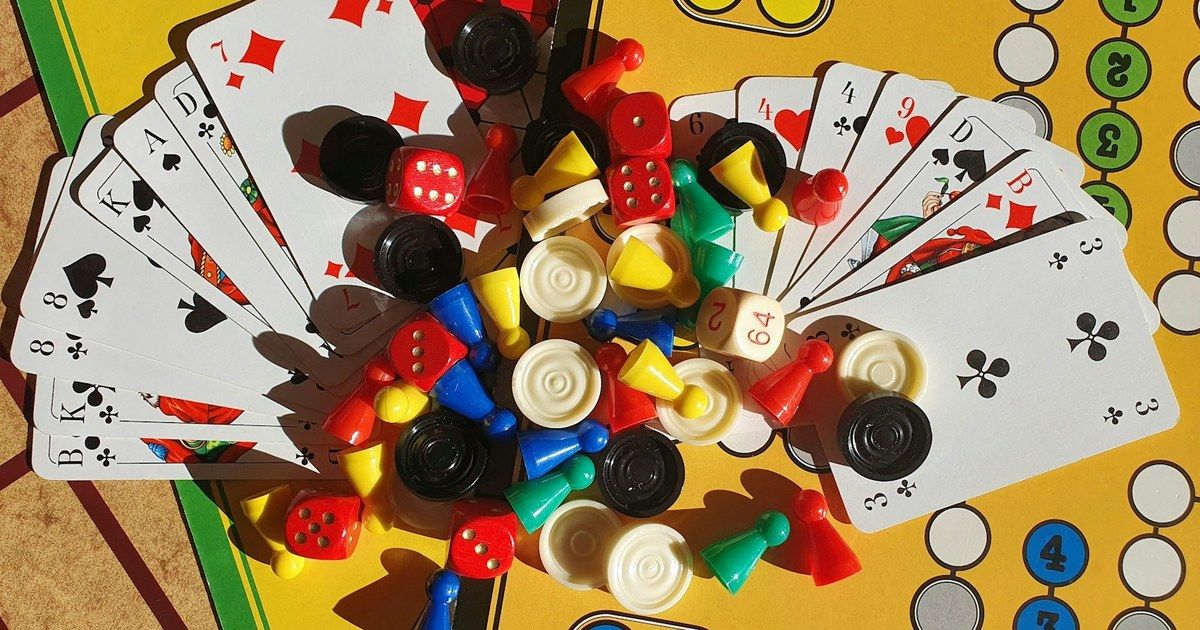
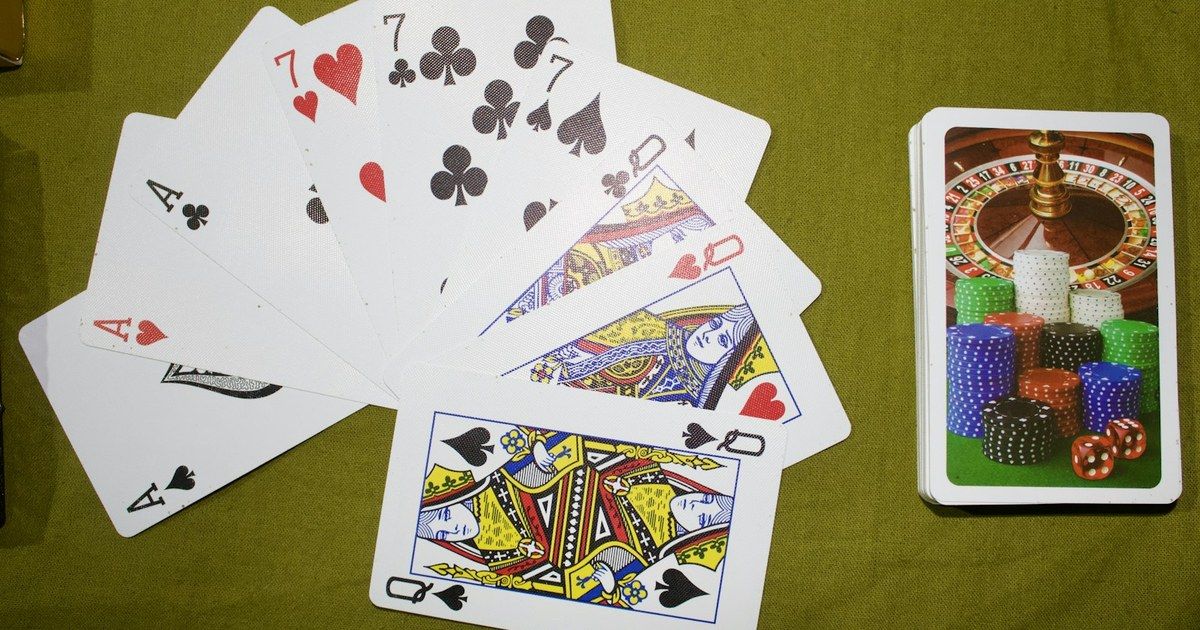
Playing cards, colored counters and dice spread across a board game

Trash Card Game Rules: 10 Slots, Wild Jacks and Winning

Trash is a layout game in which players replace hidden cards with face-up cards matching numbered positions. Start with ten slots, ace through ten. Win a hand to reduce your next layout by one slot; complete the final single slot to win the game. This guide follows the Bicycle and Pagat main version: jacks are wild, queens and kings end your turn, and a completed layout ends the hand immediately. ...
November 11, 2026 · 6 min
Two War card piles showing a tied battle and three face-down cards

War Card Game Rules: 26 Cards, Ties and Repeated Wars

War is a two-player game in which higher cards capture lower cards until one player has the whole deck. Each player starts with 26 cards. This guide uses the three-face-down variation described by Pagat, with captured cards returned to the bottom of the winner’s stack. It uses the exhaustion-means-loss option during a war, including a draw if both players run out simultaneously. What you need Use a standard 52-card deck without jokers. Each player needs space for one face-down stack; leave a shared area for contested cards. There are no chips, hand combinations or score sheets to manage. ...

November 11, 2026 · 6 min
A fan of playing cards beside poker chips and a chip case

Why Are Outs Not the Same as Equity?

Outs count cards that complete a specified improvement. Equity measures your expected share of the pot at showdown against a stated opposing hand or range, including ties. They answer different questions: making a flush is an improvement, but whether that flush wins depends on the other cards. Start by naming the improvement An out is meaningful only after you say what it completes. A card might complete your flush, give you a pair, or improve an existing pair. Those are different targets, so a count without a target is incomplete. ...

November 11, 2026 · 5 min
Playing cards and poker chips arranged beside probability notes

How to Calculate Poker Outs: A Reproducible Method

Calculating poker outs is a step-by-step mathematical method that converts unseen cards into precise completion probabilities after the flop. An out is any unseen card remaining in the deck that improves a drawing hand (an unfinished hand needing more cards) into a completed target hand. In a single-deck poker hand after the flop, exactly 5 cards are visible (your 2 hole cards plus 3 board cards) and 47 cards remain unseen. Evaluating your outs against these 47 unseen cards gives the exact probability of hitting your target hand on the next card or by the river. ...

November 10, 2026 · 6 min
Poker hands ranked from royal flush to high card with five-card probabilities

Poker Hands Chart: Rankings, Combinations, and Odds

A standard 52-card deck can produce 2,598,960 distinct five-card hands. This chart lists all ten standard high-hand categories from strongest to weakest, with the exact number of combinations and the probability of being dealt each category in a direct five-card deal. These figures describe five cards dealt from a complete deck without replacement. They are useful for comparing hand frequencies, but they are not the odds of winning a pot or the probability of completing a draw in Texas Hold’em. ...

November 10, 2026 · 5 min
Playing cards and poker chips arranged beside probability notes

Poker Odds Calculator: The Inputs Behind an Outs Calculation

This page covers the single-player outs model used by draw-completion calculators. In that model, the percentage you get is the chance that the next dealt card completes a target draw. Equity calculators that take an opponent’s cards or range and output win/tie percentages are a different tool with different inputs, and they are not covered by the formulas below. Everything here depends strictly on the number of cards you can see and the pool of cards that remain unknown. ...

November 10, 2026 · 5 min
Pot odds chart showing required equity by bet size

Pot Odds Chart: Required Equity for Every Common Bet Size

Most pot odds advice makes you do the division before you can decide. This page does the division once, for the bet sizes that come up most often, so you can read the number straight off the chart and compare it to your hand. The arithmetic behind every row is the same one described in how to calculate pot odds; if the idea of a price is new to you, start with what pot odds mean. What changes is only the bet size. ...

November 10, 2026 · 4 min
Common pot odds mistakes

Pot Odds Mistakes: Five Errors That Turn a Correct Call Into a Loss

Pot odds involve one division, which is why the mistakes are not arithmetic errors. They are framing errors: the wrong denominator, the wrong unit, or the wrong comparison. Each of the five below produces a confident answer that is wrong in a specific direction. Every example uses abstract units so the arithmetic is verifiable. If the concept itself is still unclear, read what pot odds mean first. Mistake 1: dividing by the pot before your call Pot 100, bet 50. The wrong calculation divides 50 by 150 and gets 33.33 percent. The correct calculation divides 50 by 200 and gets 25 percent. ...

November 10, 2026 · 4 min
Pot odds practice drills with worked answers

Pot Odds Practice: 10 Drills With Exact Answers

Reading a pot odds chart is a different skill from calculating pot odds under time pressure. These ten drills close that gap. Each one gives you a pot size and a bet; your job is to produce the required equity before you look at the answer. Use abstract units throughout. No drill assumes a stake level, a room or a real hand. Quick answer Required equity is the call divided by the pot after your call. The 10 drills use abstract units and cover familiar prices such as 25% for a half-pot bet and 33.33% for a pot-sized bet. Treat each percentage as a break-even threshold, then compare it with your hand’s equity; the threshold alone does not decide the call. The formula you need Required equity is the call amount divided by the pot after your call: ...

November 10, 2026 · 4 min
Pot odds compared with implied odds

Pot Odds vs Implied Odds: What Changes When You Call

Pot odds and implied odds answer two different questions about the same call. Pot odds ask what the call costs right now. Implied odds ask what the call costs once you count the chips you can still win on later streets. Treating them as two versions of the same number is the source of most confusion. If either term is unfamiliar, what pot odds mean covers the first one from scratch. They are not competing estimates. One is a floor and the other is a projection. ...

November 10, 2026 · 4 min
Play Free Now Poker instantly in your browser - no download, free chips for new players First load may take a moment - thanks for your patience.
Contact Us