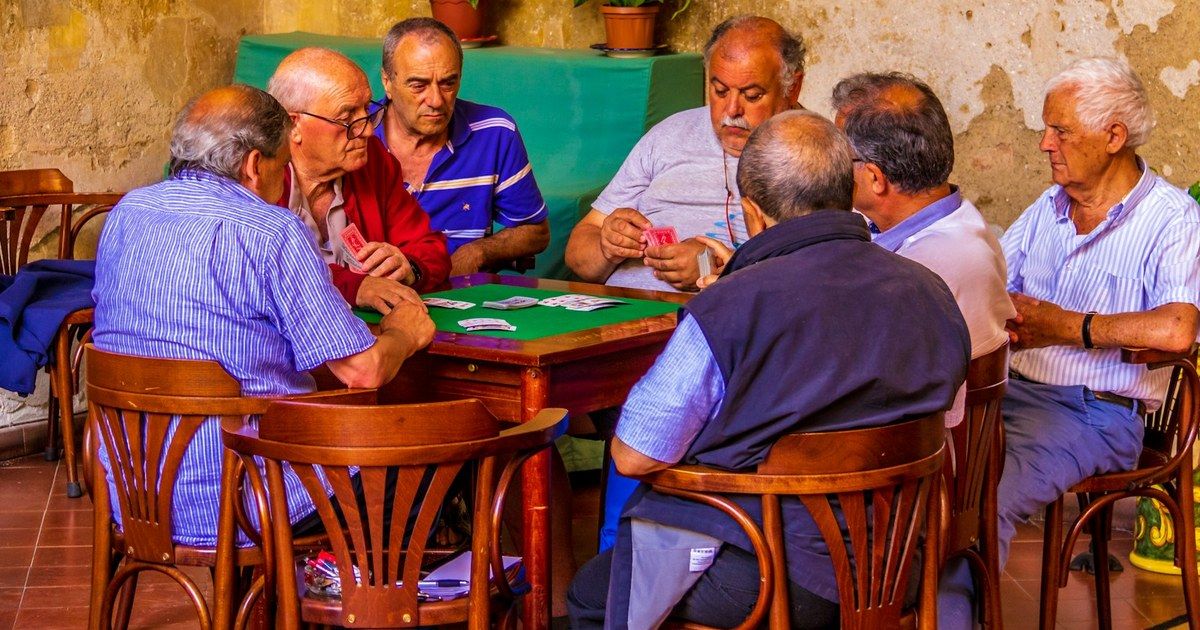
Scopa is an Italian capturing card game in which you play one card to take an equal-valued card, or table cards whose values add up to it. Clearing the table earns a sweep point, except on the deal’s final play. This guide teaches two-player Scopa with 40 cards and an 11-point target. Use the traditional deck or remove the 8s, 9s and 10s from a standard pack.
What you need
Have two players, 40 cards and a score sheet. This walkthrough uses familiar French suits, with diamonds representing the traditional coins suit. Italian packs instead use coins, cups, swords and batons.
Removing three ranks in all four suits takes 12 cards out of a 52-card pack, leaving 40. Keep A through 7 and J, Q, K. There are no jokers and no trump suit.
| Card | Capture value | Primiera value |
|---|---|---|
| A | 1 | 16 |
| 2 | 2 | 12 |
| 3 | 3 | 13 |
| 4 | 4 | 14 |
| 5 | 5 | 15 |
| 6 | 6 | 18 |
| 7 | 7 | 21 |
| J, or Italian Fante | 8 | 10 |
| Q, or Italian Cavallo | 9 | 10 |
| K, or Italian Re | 10 | 10 |
Capture value decides what you can take during play. Primiera is a separate end-of-deal comparison. A seven is especially useful in primiera, but cannot capture a king just because 21 is greater than 10.
Setup and the deal
Choose a dealer and let the opponent cut. Deal three cards each, one at a time, then four cards face up to the table. Keep the remaining 30 cards face down for later batches. If the initial table contains three or four kings, shuffle and redeal with the same dealer under the selected Pagat rules.
The non-dealer plays first, then turns alternate. Once both players have used their three cards, deal three more each. Leave existing table cards in place; do not add another four-card layout. Continue until the pack and both hands are exhausted.
With two players, the opening batch plus five later batches gives each person 18 played cards. That is 36 cards played plus four original table cards: all 40. A batch is not a new scoring deal.
How a turn works
Choose one card from your hand. What it captures depends on the table at that moment:
- Check for an equal single card. If one exists, take it with your played card. If several equal singles exist, choose one, not all of them.
- Otherwise check for a matching sum. Capture one group whose combined value equals your played card. If several groups work, choose one.
- If neither exists, leave your played card on the table. It can be captured later.
A single match has priority over a sum. With 2♣, 3♦ and 5♥ on the table, a played 5♦ must take 5♥, not 2♣ plus 3♦. You cannot take all three.
Once you choose a card that can capture, make its legal capture. You may choose a different hand card that captures nothing, however. This distinction matters: the rule does not force you to choose a capturing card from your hand.
Keep your captures, including the card you played, in your own pile. If the capture empties the table, mark one scopa, or sweep. The next player places a card onto the empty table because there is nothing to capture.
A complete six-play batch
Ben deals. The opening table is 2♣ 3♦ 5♥ 7♠. Ana’s complete hand is 5♦ J♣ 3♠; Ben’s is 7♦ K♣ 2♥. These ten cards are all different.
| Turn | Play and result | Table afterward |
|---|---|---|
| Ana | 5♦ takes the matching 5♥, not 2♣ + 3♦ | 2♣ 3♦ 7♠ |
| Ben | 7♦ takes 7♠ | 2♣ 3♦ |
| Ana | J♣ is worth 8; no available group totals 8, so leave it | 2♣ 3♦ J♣ |
| Ben | K♣ is worth 10; takes 2♣ + J♣ | 3♦ |
| Ana | 3♠ takes 3♦ and clears the table: one scopa | Empty |
| Ben | 2♥ cannot capture on an empty table; leave it | 2♥ |
Both hands are empty. Ana has captured four cards and Ben five; one remains on the table and 30 remain to be dealt. The check is 4 + 5 + 1 + 30 = 40. Deal another three cards each without disturbing 2♥.
This batch is complete, but the deal is not. Ana’s sweep counts because it was not the final play of the entire 40-card deal.
How a deal ends and scores
After the last cards have been played, give any table leftovers to the player who last made a capture. This cleanup earns no sweep. Neither does a capture that clears the table on the dealer’s very last play of the deal.
| Category | Points | Tie rule |
|---|---|---|
| Each recorded scopa | 1 each | Count each player’s sweeps |
| Most captured cards | 1 | A 20-20 split awards neither player |
| Most diamonds | 1 | A 5-5 split awards neither player |
| Settebello, the 7♦ | 1 | Awarded to its capturer |
| Best primiera | 1 | Equal totals award neither player |
For primiera, select your highest primiera-valued captured card in each suit and total those four values. Missing a suit makes you ineligible; three excellent suits do not replace a fourth. The 7♦ may contribute to both settebello and primiera because these are separate categories.
Here is the final count from one legal continuation of the worked opening. It is an example result, not a prediction about the better player:
| Category | Ana | Ben |
|---|---|---|
| Captured cards | 19: 0 points | 21: 1 point |
| Diamonds | 5: 0 points | 5: 0 points |
| 7♦ | Not held: 0 | Held: 1 |
| Best club, diamond, heart, spade | 6♣ 6♦ 7♥ 6♠ | 7♣ 7♦ A♥ 7♠ |
| Primiera | 18 + 18 + 21 + 18 = 75: 0 points | 21 + 21 + 16 + 21 = 79: 1 point |
| Sweeps | 2 points | 1 point |
| Deal score | 2 | 4 |
Ben has won three comparison categories despite the tied diamonds. Ana’s two sweeps still count. Add these results to the running score and alternate dealer. At the end of a deal, a player on at least 11 wins if ahead. If both reach 11 or more and tie, play another deal.
Variations to keep separate
This is matching-value Scopa, not Escoba’s make-15 capture system. We do not add an ace-takes-all rule, extra points for the king of diamonds, or a bonus for collecting a diamond sequence. We also use the full primiera calculation, not “most sevens wins” as a shortcut.
If you would rather build melds than capture table cards, compare Basic Rummy and Gin Rummy. Their sets and runs are not Scopa capture rules.
FAQ
Can I capture a sum when a matching single exists?
No. Take one equal-valued single first. You choose a sum only when no equal single is available for the card you played.
Can I play with a normal 52-card deck?
Yes, after removing every 8, 9 and 10. J, Q and K then count as 8, 9 and 10 for capturing; their printed letters do not change that table.
Does the last sweep count?
Only if it is before the final play of the whole deal. Clearing the table on that final play, or collecting leftovers afterward, earns no scopa point.
Does holding the most sevens automatically win primiera?
Not under this version. Select the best card in each suit using the primiera scale, then compare totals. Suit coverage and the other ranks can change the result.
Sources
- Pagat: Scopa, the selected two-player rules, capture priority, scoring and variation boundaries.
Data Used
The examples are original. A legal 40-card continuation was checked for conservation and scoring; its trace accompanies the drafts. No optimal-play claim is made.
Educational content. 18+ only.